Most bedroom storage advice starts under the bed. In a small bedroom, the thing that decides whether the room works is the floor beside it: room to step out of bed, make the bed and open a drawer without turning sideways.
A useful benchmark is the clear floor space defined in the ADA Standards, at least 30 inches by 48 inches, which they require beside beds in guest rooms with mobility features. Your own bedroom does not have to follow that rule, and many small rooms cannot fit it on both sides. As a comparison number, it is easy to test and it protects the part of the room you use every day.
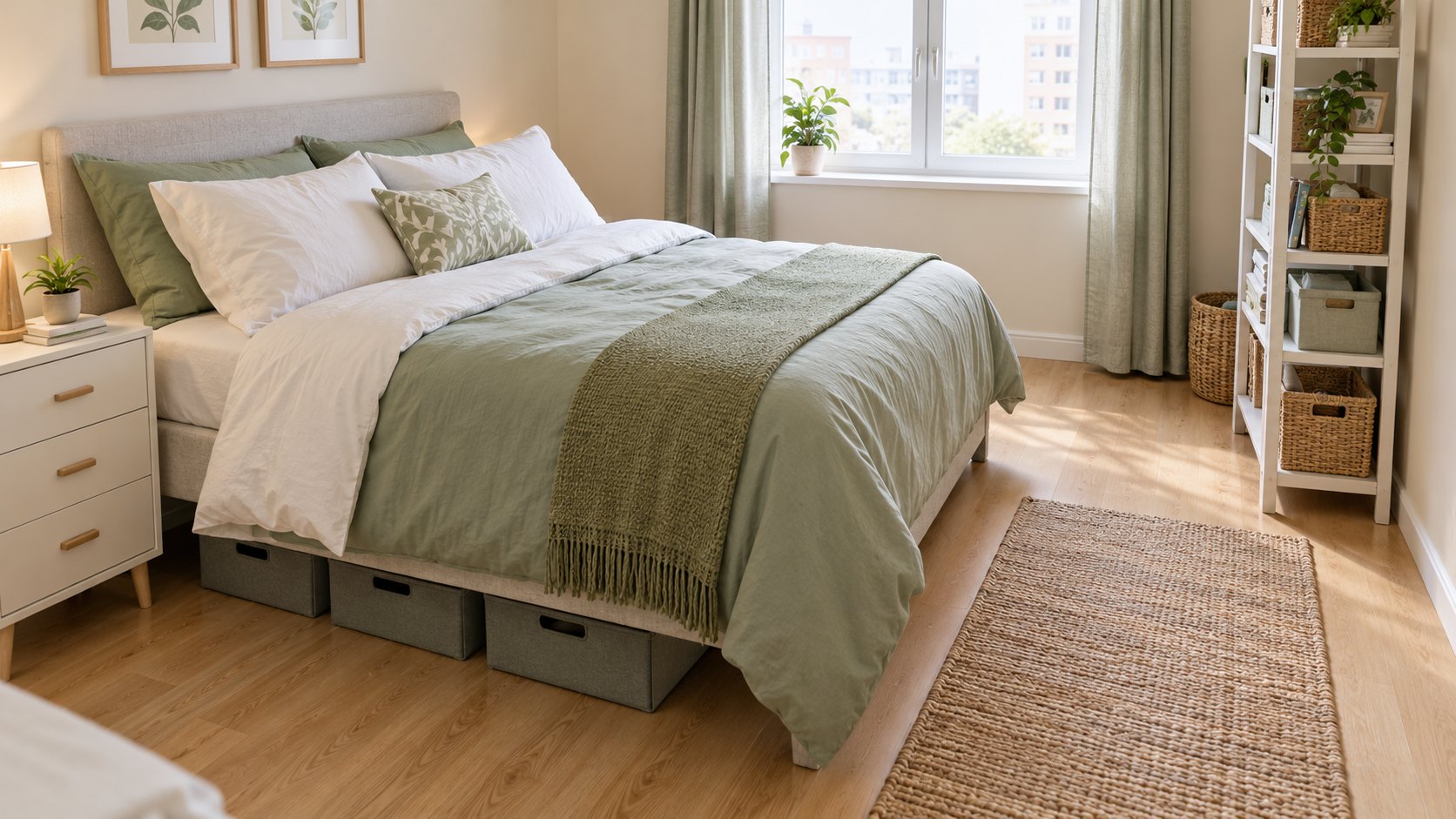
The cover photo shows the idea: a clear floor strip beside the bed, a nightstand with drawers, a tall slim shelf against the wall and flat bins under the bed frame. This guide shows how to plan that layout, set heights by reach, use the space under the bed safely and keep tall furniture from tipping. For the DIY drawer build, see our under-bed drawers and rolling bins guide .
1. Measure the Room Around the Bed
Measure first and write the numbers on a sketch:
- Room width and length.
- The bed’s footprint, for example 60 by 80 inches for a queen.
- The gap between the bed and the wall on each side and at the foot.
- Door swing for the bedroom door and for the closet.
- Windows, radiators and outlets that furniture must not block.
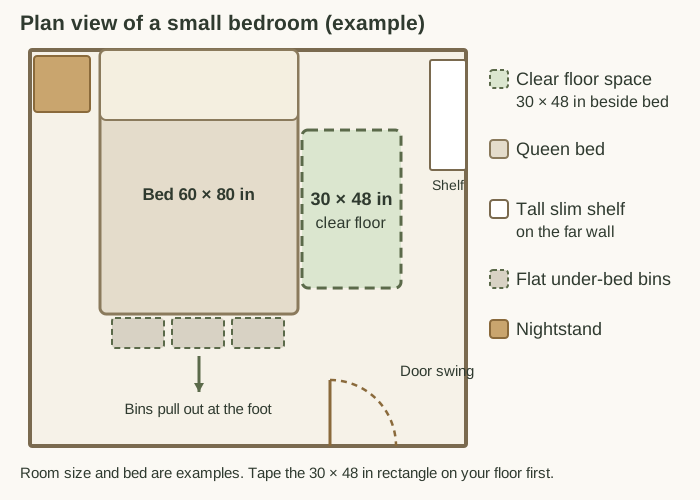
Then draw the room to scale on paper, or use tape on the floor. The diagram shows a sample plan: the bed against one wall, the clear floor beside it, a tall shelf on the far wall and bins at the foot.
2. Protect the 30-by-48-Inch Space
The ADA Standards set the minimum size of clear floor space at 30 inches by 48 inches, and for beds they call for it to be positioned beside the bed for a parallel approach. The standard has an exception: one clear space between two beds can serve both. Those rules apply to specific buildings, such as hotel guest rooms with mobility features, so treat them as a comparison, not a requirement for your home.
Here is how to use it in a small room:
- Tape a 30 by 48 inch rectangle on the floor beside the bed, next to the side you use to get in.
- If the room cannot fit one on each side, protect one side and use the other for a nightstand or the wall.
- Keep the rectangle clear of door swings, laundry baskets and loose furniture.
- Do not count a drawer that opens into the rectangle as free space. Check that it still leaves room.
If the rectangle does not fit at all, move the bed, choose a narrower nightstand or switch to a wall-mounted light before you buy more storage.
3. Decide What Goes Where
Think in zones around the bed, not a list of furniture:
- Bedside: the few things you reach for in the dark or on waking, such as a phone, glasses, a book and a lamp.
- Far wall: a tall slim shelf with baskets for things you use weekly.
- Foot of the bed: flat bins for seasonal bedding and clothes, pulled out toward the foot.
- Closet or wall hooks: clothes and accessories. Our renter closet guide and small closet guide cover this.
Give every item one zone. If something has no zone, it probably does not belong in the bedroom.
4. Set Heights by Reach
The ADA Standards describe an unobstructed forward reach of 15 to 48 inches above the floor. Your bedroom does not have to meet them, but they make a handy comfort range for deciding what goes at what height.
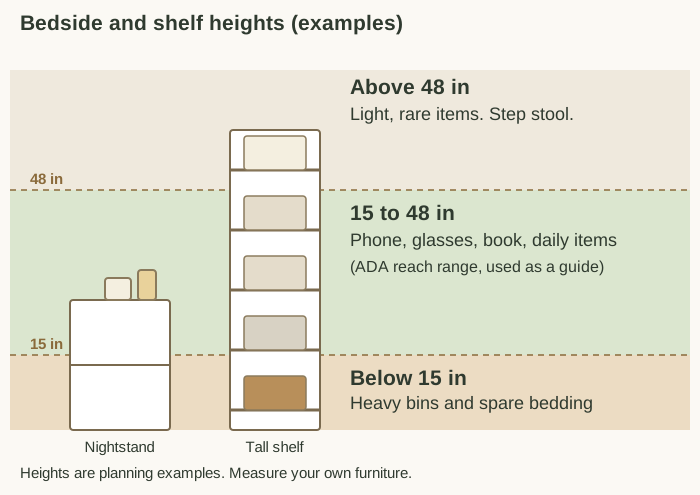
- 15 to 48 inches: daily items such as the phone, glasses, a book, a water glass and the shelf’s front baskets.
- Below 15 inches: heavy bins and spare bedding. Lifting is easier from low than from above shoulder height.
- Above 48 inches: light, rarely used items, reached with a small step stool. Never climb on the bed or a chair.
The nightstand in the diagram is an example. If yours is taller or shorter, keep the same logic: the most-used items go in the middle band.
5. Use Under-Bed Space for What It Does Best
Under-bed storage is best for flat, light, seasonal items such as spare bedding, off-season sweaters and luggage. It is the worst place for things you need daily.
Measure from the floor to the lowest part of the frame at several points, because floors and frames are not always level. Then:
- Choose flat bins at least 1 inch shorter than the smallest reading.
- Prefer bins that pull out toward the foot of the bed, so they never block the clear side.
- Use soft fabric bins if the gap is low, and rigid lidded bins if it is taller.
- Leave a little room around each bin so pulling one does not drag the next.
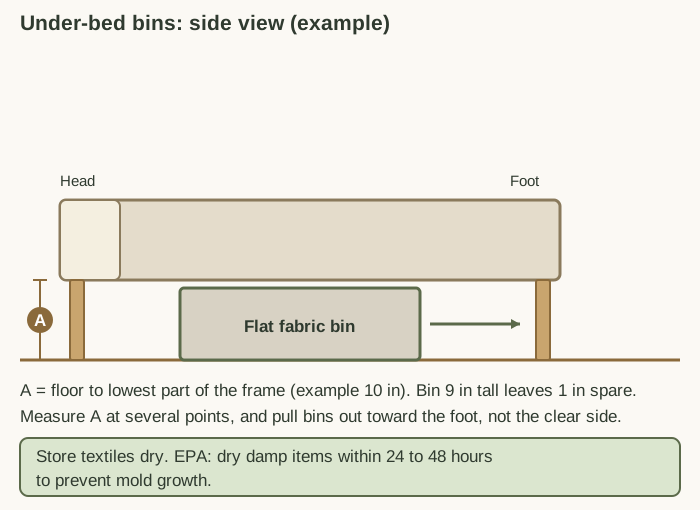
Keep textiles dry. The EPA advises drying damp items within 24 to 48 hours to prevent mold growth, so never put damp towels, blankets or clothes in a closed bin under the bed.
6. Anchor Tall Furniture
A tall slim shelf and a chest of drawers are both tip-over risks, especially where children visit. Salud America, summarizing the CPSC’s Anchor It! campaign, reports that tip-overs usually occur in the bedroom, advises securing top-heavy furniture with anti-tip brackets, and recommends removing items that tempt children to climb, such as toys and remote controls, from the top of furniture.
In a rental, ask your landlord before you anchor, because anchors leave small holes in the wall. If anchoring is not allowed, choose a low piece instead of a tall one and keep heavy items on the lower shelves.
7. Keep Bedding and Clothes Dry
A bedroom with bins, baskets and a closet should not hold moisture. Open a window briefly each day, keep damp laundry out of the room and check bins once a season. If you find a damp or musty item, dry it and look for the source before you refill the bin.
8. Mistakes to Avoid
- Filling the clear space. A bench or basket in the 30 by 48 inch rectangle defeats the point.
- Buying bins before measuring. The gap under the frame is rarely uniform.
- Storing daily items under the bed. You will stop using them, or stop making the bed.
- Placing a tall unit where a door swings. Check swings with the door open and closed.
- Skipping the anchor. A loaded shelf can tip.
- Using the bedside for everything. A crowded nightstand is a sign something needs a zone.
9. A 20-Minute Reset
Once a month, set a timer. Return stray items to their zone, clear the bedside to the essentials, check that the clear floor space is still clear, pull out one bin and look for dampness, and check that the shelf is still firm against the wall. A short reset keeps the system from drifting back to clutter.
10. Try This Weekend
Tape the 30 by 48 inch rectangle on the floor beside the bed. Live with it for three days and see what you trip over, move or ignore. Then choose storage that fits around the tape, not the other way round. For the rest of a studio plan, see our 350 square foot apartment guide and the small bedroom floor-first plan .
Frequently Asked Questions
How much clear space should I keep beside a bed?
The ADA Standards define a clear floor space as at least 30 inches by 48 inches, and they require it beside beds in guest rooms with mobility features. Your own bedroom does not have to meet that rule, but it is a practical benchmark for getting in and out of bed and making it.
Where should storage go if my bedroom is very small?
Keep one side of the bed clear first. Then use the far wall for a tall slim shelf, the foot of the bed for flat bins that pull out toward the foot, and the closet for hanging clothes. Do not fill the walking path to gain a shelf.
How high should bedside items be?
The ADA Standards describe an unobstructed forward reach of 15 to 48 inches above the floor. Keep the phone, glasses and book inside that band, heavy bins below it and light, rarely used items above it with a step stool.
How do I choose under-bed bins?
Measure from the floor to the lowest part of the frame at several points, then choose flat bins at least 1 inch shorter than the smallest reading. Pick bins that pull out toward the foot of the bed and keep them clear of the side you use to get in.
Do I need to anchor a tall shelf or dresser?
Securing top-heavy furniture with anti-tip brackets is the advice of the CPSC’s Anchor It! campaign, as summarized by Salud America, which also reports that tip-overs usually occur in the bedroom. In a rental, ask your landlord first, because anchors leave small holes.
Can I store blankets or clothes under the bed?
Yes, if they are clean and dry. The EPA advises drying damp items within 24 to 48 hours to prevent mold growth, so never store damp textiles in a closed bin.
Sources
- US Access Board, ADA Standards for Accessible Design : clear floor space of at least 30 by 48 inches (305.3) and the sleeping area requirement beside beds in guest rooms with mobility features (806.2.3).
- US Access Board, ADA Chapter 3: Operable Parts : the 15 to 48 inch unobstructed forward reach range.
- US EPA, A Brief Guide to Mold, Moisture and Your Home : dry damp items within 24 to 48 hours to prevent mold growth.
- Salud America, Anchor It: Protect Kids from Dangerous Furniture Tip-Overs : a summary of the CPSC Anchor It! campaign, with the bedroom as the usual place for tip-overs, anti-tip brackets and removing tempting items from furniture.
The diagrams are original illustrations made for this guide. Room sizes, bed sizes and heights are planning examples, so measure your own room and follow the manufacturer’s instructions for furniture and anchors.
Image Credits
- Cover: AI-generated image via ChatGPT, October 2026.