A small home rarely becomes difficult because it lacks storage everywhere. More often, a few high-traffic areas have no clear system, so the same objects move from one surface to another every day.
The goal of good organization is therefore not to fill every empty corner. It is to make the things you use often easy to reach, give categories a predictable home, and remove the items that are consuming space without earning it.
Quick answer: sort one problem area in 15 to 20 minutes, give each room a single job, keep everyday items between 15 and 48 inches off the floor, buy containers only after measuring, and repeat a ten-minute reset each week. Do those five things in that order before spending anything.
This guide uses a simple sequence: edit what you own, create zones, use vertical space, then build a reset routine. The approach works for apartments, small houses, and rental homes.
1. Start With a Fast Decluttering Pass
Do not empty the entire house at once. Choose one visible problem area and work in a small batch.
Prepare three destinations:
- Keep: used and useful items that belong in the space.
- Move: things you want but that belong somewhere else.
- Remove: rubbish, duplicates, broken items, or things you no longer need.
The important part is speed. Give yourself 15–20 minutes and make decisions without creating a new “sorting room” elsewhere.
When you are unsure about something, ask three practical questions:
- When did I last use it?
- Would I replace it if it disappeared?
- Is this the best place for it?
Do not buy organizers during this first pass. Storage cannot solve an excess-of-stuff problem; it can only make the remaining items easier to manage.
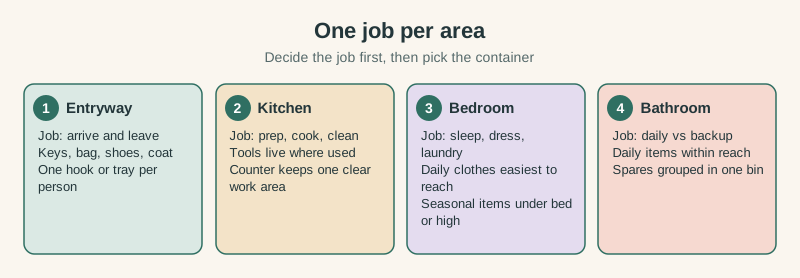
2. Give Every High-Traffic Area One Job
A useful small-space system starts with zones rather than containers.
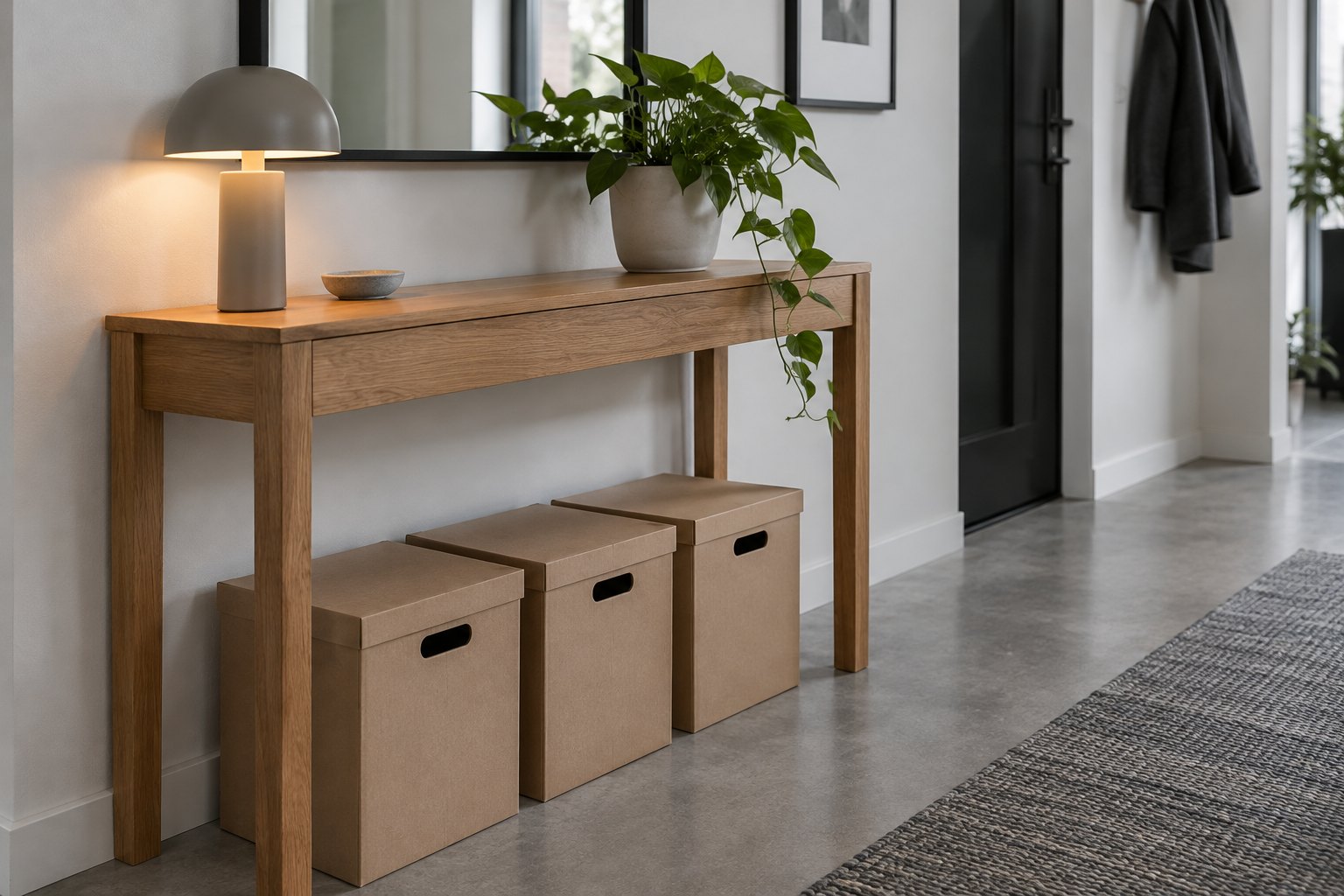
In an entryway, the zone might be arrive and leave: keys, bags, shoes, coats, and anything that needs to go out with you.
In a kitchen, separate prep, cooking, cleaning, and food storage. Items should live near the activity where they are used rather than wherever an empty drawer happens to exist.
In a bedroom, create a sleep zone, dressing zone, and laundry zone. In a bathroom, separate everyday products from backups and occasional items.
A zone does not need a physical divider. A shelf, drawer, tray, basket, or small section of a cabinet can define it.
The test is simple: when you finish using an item, can you put it away without thinking?
3. Use Vertical Space Before Adding More Floor Furniture
When floor space is limited, the walls often offer the cleanest opportunity for additional storage.
Consider:
- Floating shelves for lightweight everyday items
- Tall shelving for less frequently used supplies
- Hooks for bags, coats, towels, or cleaning tools
- The back of a door for small, lightweight categories
- Wall-mounted kitchen storage for utensils and mugs
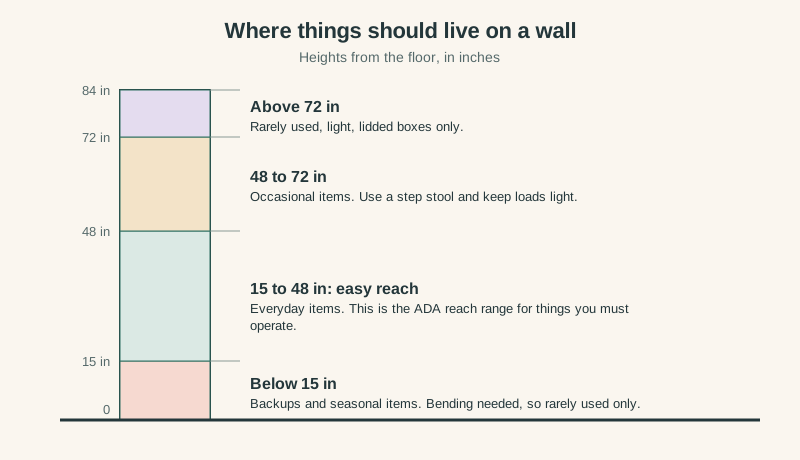
Use heights deliberately. The ADA Standards set the unobstructed reach range for operable parts at 15 to 48 inches above the floor, which makes a practical rule for everyday items: put what you touch daily inside that band, and move occasional items above 48 inches and backups below 15 inches.
Avoid turning every wall into storage. A few purposeful vertical elements usually look calmer than a collection of small organizers scattered everywhere.
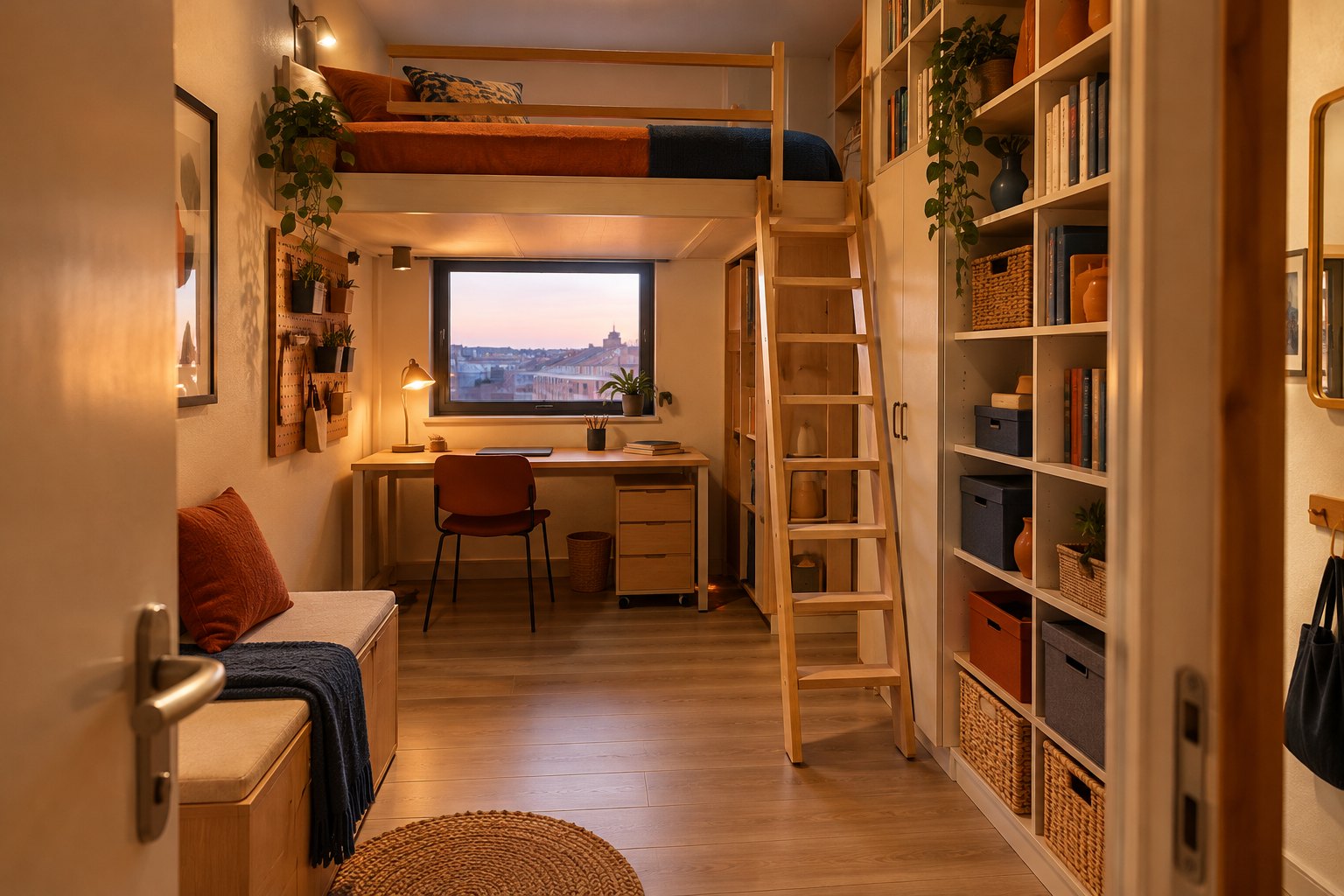
For rented homes, prioritize solutions that do not require permanent changes when that suits the property rules. Freestanding shelves and narrow carts can provide vertical or gap storage without becoming a major installation.
4. Make the Kitchen Easier to Reset
Kitchen clutter returns quickly because the room handles several activities every day.
Start by clearing the countertop and deciding what genuinely needs to remain there. A coffee maker that is used several times a day may deserve permanent space. A rarely used appliance may not.
Group storage around tasks:
Prep: knives, cutting boards, mixing bowls, and the tools you use most.
Cooking: pans, utensils, seasonings, and heat-safe tools close to the cooking area.
Cleaning: dish soap, cloths, brushes, and dishwasher supplies near the sink.
Food: everyday ingredients where they are visible and easy to return.
For pantry shelves, avoid creating deep layers where the back disappears. A smaller number of visible categories is often more useful than maximum capacity.
The best kitchen is not the one that stores the most. It is the one that can be reset quickly after cooking.
5. Make Bathroom Storage Visible but Contained
Bathrooms often feel cluttered because many small products have different shapes and are used at different frequencies.
Create three groups:
- Daily products
- Occasional products
- Backups
Keep daily products within easy reach. Put backups together rather than allowing spare bottles to occupy every shelf.
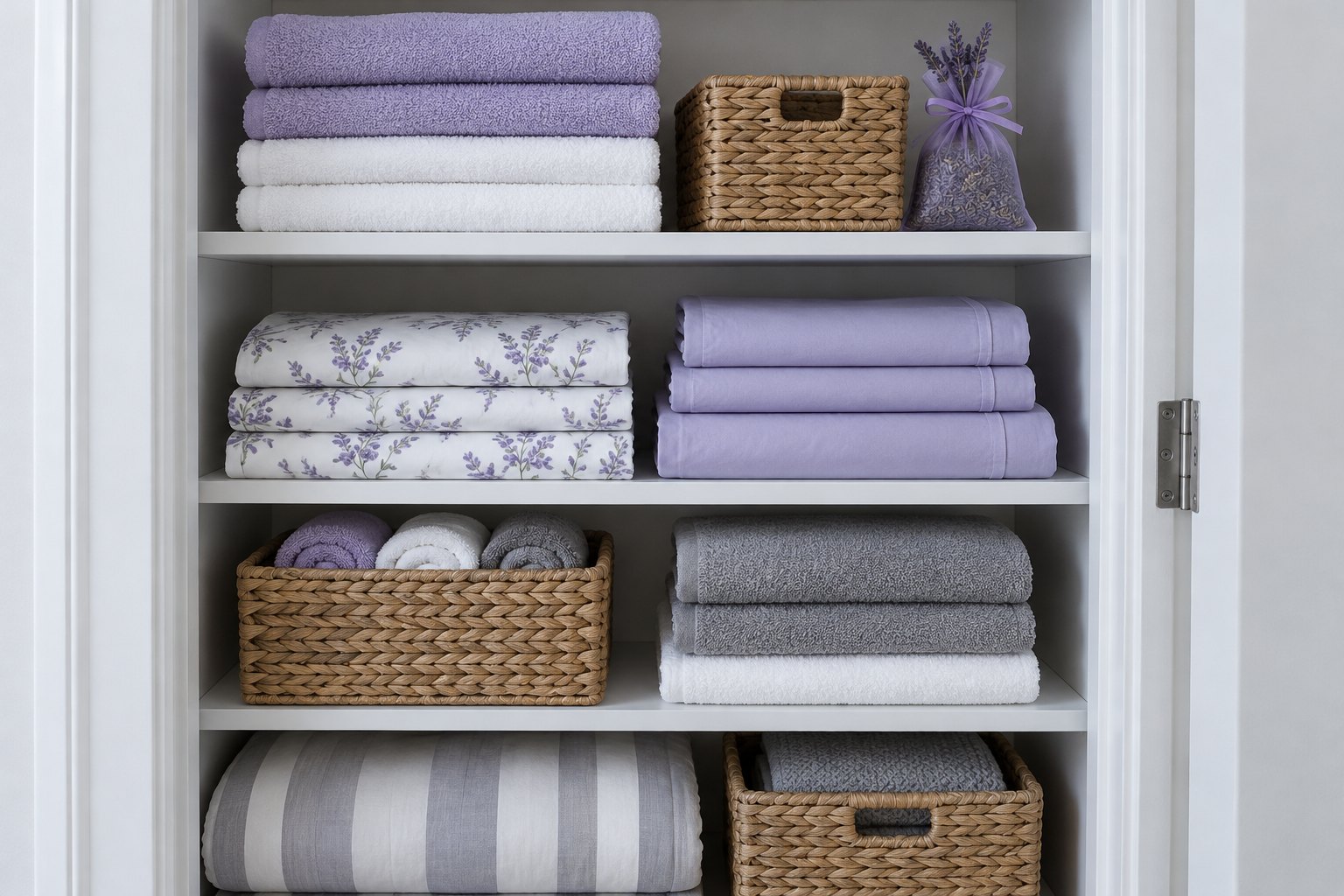
Open baskets or shallow containers can help because the contents remain visible. Use one for hair-care items, one for cleaning supplies, or one for spare towels, depending on the room.
Bathrooms are damp, so do not pack shelves tight against the wall. The EPA advises keeping indoor relative humidity below 60 percent, ideally between 30 and 50 percent, and good airflow around stored towels and backups helps. If the room stays damp, run the fan during and after showers.
Avoid buying a large matching set of containers just for appearance. Measure the shelf first and choose pieces that fit the actual depth and height.
If a product repeatedly ends up on the counter, treat that as feedback. Its storage location may be too inconvenient.
6. Use the Bedroom’s Hidden Storage First
The bedroom is often where small homes lose useful floor space to furniture.
Before adding another dresser, check the storage you already have:
- Under the bed
- The back of the bedroom door
- The top section of the closet
- The wall above a desk or dresser
- Unused space beside the wardrobe
Under-bed storage works best for categories that are not needed every day, such as seasonal clothing, spare bedding, or luggage accessories.
In the closet, keep everyday clothing in the easiest-to-reach area. Move seasonal or occasional items higher or farther back.
Keep bins and floor storage away from the path to the door and any window you might need to use. NFPA recommends planning two ways out of every room, and a full under-bed or floor-level system can quietly block one of them.
Do not compress the closet so tightly that putting clothes away becomes difficult. A system that looks efficient but requires wrestling with every hanger will not last.
7. Choose Containers Only After Measuring
Containers should fit the problem, not create a new one.
Before buying anything, measure:
- Width
- Depth
- Height
- Door or drawer clearance
- Obstructions such as hinges, pipes, and trim
Then choose the simplest container that solves the problem.
Clear bins are useful when seeing the contents matters. Open baskets are convenient for frequently used items. Lidded boxes make sense for seasonal or protected storage.
In a pantry, matching containers can make shelves easier to scan, but transferring everything into containers is not mandatory. Keep original packaging when it is more practical.
Leave some empty capacity. A container that is permanently overfilled becomes another clutter source.
8. Turn Awkward Gaps Into Useful Storage
Small homes contain narrow spaces that can be useful without becoming dumping grounds.
Examples include:
- A slim rolling cart beside an appliance
- Hooks behind a door
- A narrow shelf above a desk
- A shallow cabinet organizer
- A small basket on a high closet shelf
The rule is to give the gap one category.
A narrow cart might be for pantry supplies. A door organizer might be for accessories. A high shelf might be for seasonal items.
Do not buy an organizer simply because a gap exists. First decide what problem the space should solve.
If the answer is “anything that does not have a home,” the organizer is likely to become a clutter collector.
9. Keep Useful Surfaces Partly Empty
A kitchen counter with a clear working area is easier to clean. A bathroom vanity with one open section feels less crowded. A bedroom dresser with some visible surface makes it easier to notice when clutter is returning.
Use trays to contain small groups of objects rather than allowing them to spread.
For example, an entry tray can hold keys and everyday pocket items. A bathroom tray can group the few products used every morning. A desk tray can contain chargers and stationery.
When a tray becomes full, that is a signal to edit the contents rather than find a larger tray.
10. Build a Ten-Minute Weekly Reset
The final part of organization is maintenance.
Once or twice a week, run the same short sequence:
Minutes 1–2: return misplaced objects to their zones.
Minutes 3–4: clear the most visible surface in each main room.
Minutes 5–6: empty temporary baskets and deal with the “move” pile.
Minutes 7–8: return daily-use products to their normal positions.
Minutes 9–10: identify one recurring problem and change the system if necessary.
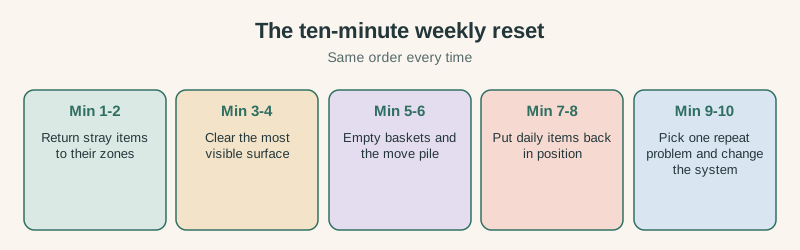
The last step matters. If shoes always collect beside the door, perhaps the shoe storage is too far away. If clean laundry always lands on a chair, perhaps the bedroom needs a temporary laundry zone.
Do not respond to every recurring problem by buying another container. Sometimes the best improvement is moving an existing item closer to where the action happens.
A Simple Small-Home Checklist
- Remove duplicates and unused items first.
- Give each high-traffic area a clear purpose.
- Keep frequently used items easy to reach.
- Use vertical and hidden space before adding floor furniture.
- Measure storage spaces before buying containers.
- Keep backups separate from everyday supplies.
- Leave some useful empty space on shelves and surfaces.
- Give every basket or bin one clear job.
- Reset the home for ten minutes each week.
- Change a system when the same clutter keeps returning.
A well-organized small home is not one where every inch is occupied. It is a home where the things you use have obvious places, the things you do not need have been removed, and everyday routines require very little effort to maintain.
Frequently Asked Questions
What should I organize first in a small home?
Start with the area that creates the most daily friction, usually an entryway, kitchen counter, bedroom floor, or bathroom surface. Clear it, assign zones, and test the system before buying storage.
Should I buy storage containers before decluttering?
Usually no. Remove duplicates and unused items first, measure the remaining space, then buy only the containers that solve a specific storage problem.
How do I make a small home look less cluttered?
Reduce visible categories, use consistent storage where it helps, keep frequently used items easy to reach, and leave some empty space on shelves and surfaces.
How often should I reset an organized home?
A short five-to-ten-minute reset once or twice a week is usually easier to maintain than waiting for clutter to become a large project.
How can renters add storage without major changes?
Favor freestanding shelves, slim carts, removable hooks where appropriate, over-door organizers, and storage that uses existing vertical or under-bed space.
Sources
- Access Board: ADA Standards guide, Chapter 3 Operable Parts for the 15 to 48 inch unobstructed reach range used above.
- U.S. EPA: A Brief Guide to Mold, Moisture and Your Home for the recommended indoor relative humidity range.
- NFPA: Escape planning for planning two ways out of each room.
The diagrams in this guide are original illustrations created for this site.
Image Credits
- Cover: AI-generated image via ChatGPT, October 2026.