A living room asks for power in three places that rarely sit next to an outlet: the TV wall, the lamp beside the sofa and the corner where phones charge. Without drilling, the usual result is cords draped across the floor, pushed under a rug or knotted behind the console.
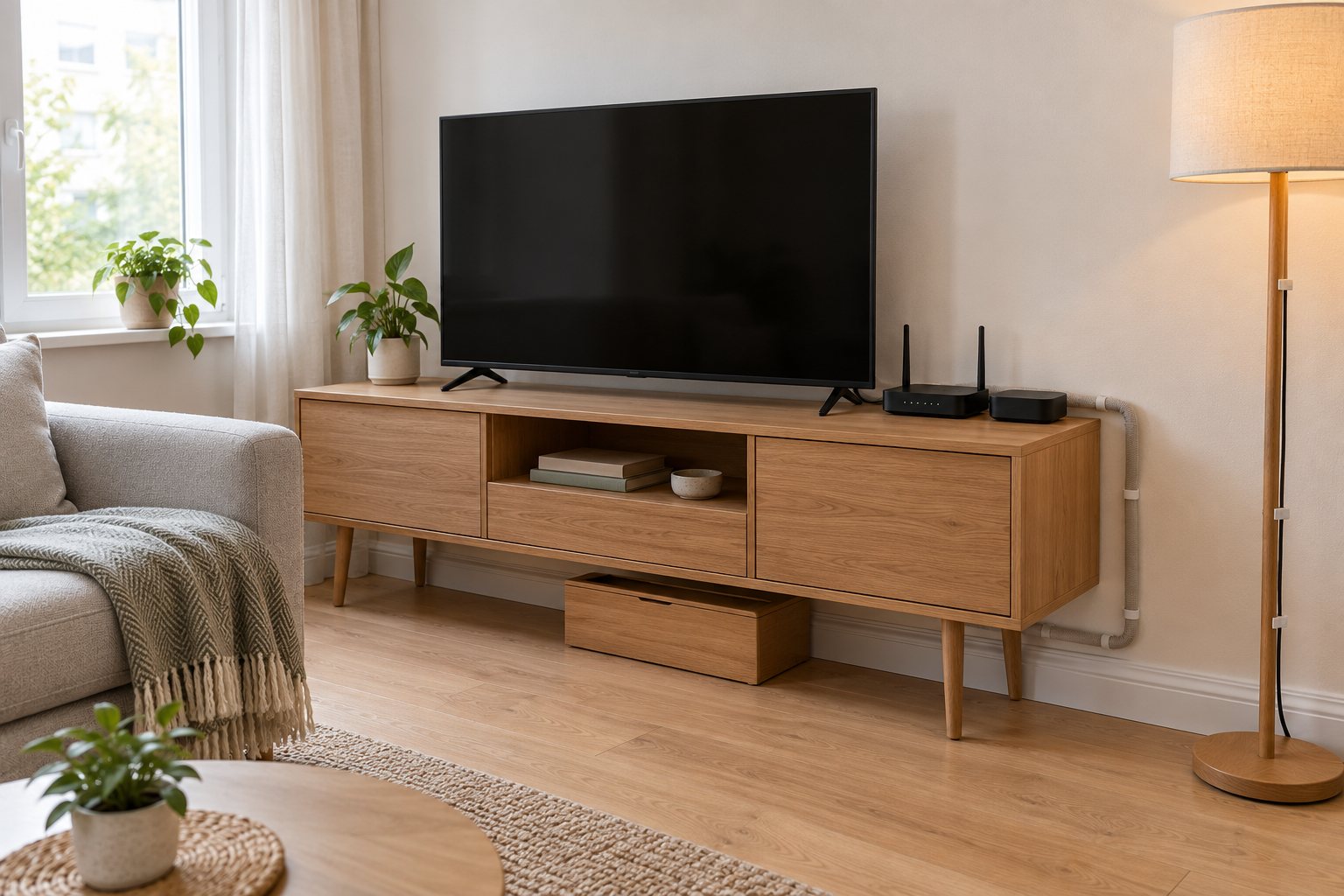
This guide builds a renter-safe setup around the layout in the cover photo: a cord raceway on the wall, small clips on the baseboard and the lamp pole, and a power strip kept off the open floor. The safety rules come first, because a hidden cord that overheats is worse than a visible one. If your problem is furniture and layout rather than cords, start with Small Living Room Storage for Renters: A Layout-First Plan .
1. Draw a Cord Map Before You Buy Anything
Trace every cord from the device to the outlet and write it down. Note for each cord where it starts, where it ends and whether it carries power or only data, such as HDMI or ethernet. Power cords need the safety rules in this guide. Data cables can be tied and clipped freely.
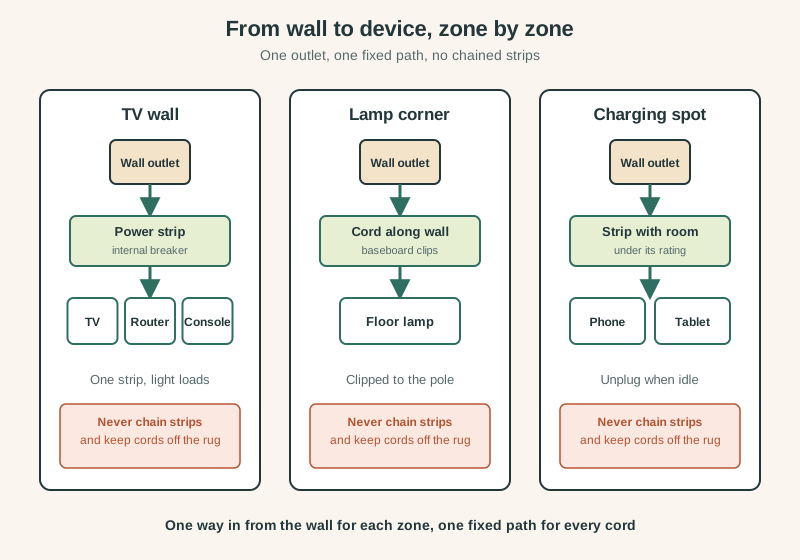
The map shows how many outlets you really use and where cords cross open floor. Those crossings are what people trip over and what pets reach first. Most living rooms have three zones, shown below: the TV wall, the lamp corner and the charging spot. Each zone should have exactly one way in from the wall, and every cord inside it should follow a fixed path.
2. Count Outlets and Loads Before You Hide Anything
A university safety office points out that heavy reliance on extension cords is a sign you have too few outlets for what you own. A TV, a streaming box, a router and a game console are a light load for one power strip, and the Seattle Fire Department describes strips as suited to light loads such as computers, printers and clocks.
Anything that makes heat, such as a space heater, draws far more than a power strip is meant to handle and should be plugged straight into the wall. If the room simply has too few outlets, the safe fix is more outlets, not longer cords. Ask your landlord whether one can be added, or have a qualified electrician do it.
3. One Power Strip Per Outlet, Never Chained
The Seattle Fire Department advises having only one power strip or surge protector plugged into a single duplex outlet, and never connecting one strip or extension cord to another. This practice is called daisy chaining, and it is the first thing to undo when you tidy a living room. Look for a strip with an internal circuit breaker that trips when it is overloaded.
Read the label before you plug anything in. Add up the wattage printed on your devices and stay well below the maximum rating of the strip. If a strip, cord or plug feels hot to the touch while it is in use, stop using it and replace it. Never cut off the ground pin to make a three-prong plug fit a two-slot outlet; ask your landlord about a properly grounded outlet instead.
4. Give the Power Strip a Home Off the Open Floor
The cover photo keeps a low wooden box under the console, a common way to hold a strip so the plugs are not in view and not underfoot. The idea works only if the box does not trap heat. The University of Tennessee safety office warns that covering a cord hides damage and traps heat, which is the reason cords should never go under rugs or other cover.
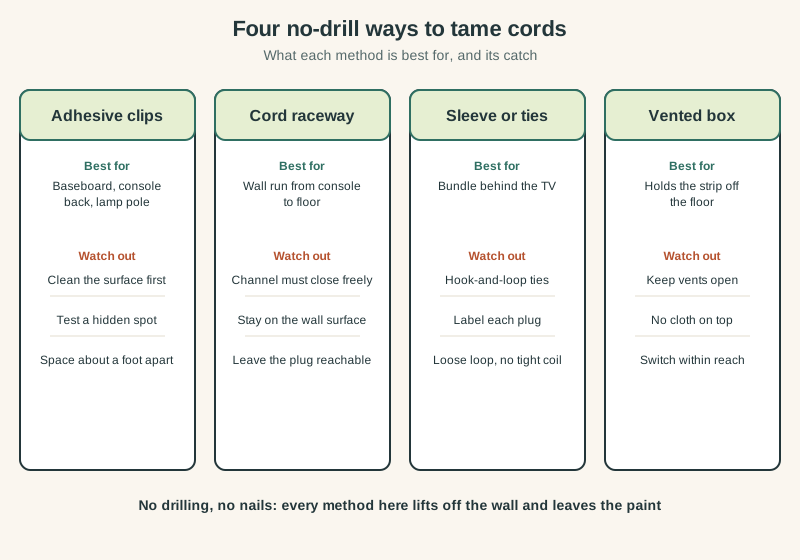
Pick a box with ventilation slots or an open back, leave a gap around the strip and never pack cloth, paper or chargers on top of it. Keep the power switch reachable without moving furniture.
5. Adhesive Clips Along the Baseboard and Console Back
Self-adhesive cord clips are the simplest no-drill tool. Clean the surface with rubbing alcohol, let it dry, press each clip firmly for the time the package states and wait before loading it with a cord. Space clips about every foot so the cord never sags between them.
Run cords along the top edge of the baseboard or the back edge of the console, where they stay close to the wall and out of foot traffic. Use gentle curves at corners, because a sharply bent cord can be damaged. Never fasten a power cord with staples or nails; they can crush the insulation, and they are not an option in a rental anyway. Test one clip in a hidden spot first, since adhesive can lift paint from some walls.
6. A Cord Raceway for the Gap Between Console and Outlet
The cover photo shows a pale raceway running down the wall from the console and along the baseboard toward the outlet. A raceway is a plastic or fabric channel with an adhesive back that holds several cords in one tidy line, and many come in paintable or neutral colors.
Measure the bundle you need to cover and choose a channel that closes without squeezing the cords. Stick it to the wall surface, never through a wall, doorway or floor, which the University of Tennessee safety office lists as places cords should not be run. Leave the plug end outside the channel so you can unplug a device easily. When you move out, warm the adhesive gently with a hair dryer and peel slowly, following the product instructions.
7. Sleeves and Ties for the Bundle Behind the TV
Behind the TV, the problem is not the floor but the knot. Gather the power cord and the data cables for each device into a fabric or spiral sleeve, or tie them with reusable hook-and-loop ties that you can undo without scissors. Give each power cord enough slack that it is not pulled tight at the plug.
Label each plug with a small tag, such as the device name written on a strip of masking tape, so you unplug the right one in a hurry. Fold extra length into a loose loop and tie it in the middle rather than winding a tight coil, which can hold heat while the device is running.
8. The Lamp Cord: Clips on the Pole, No Dangle
In the cover photo the lamp cord is held against the pole by small white clips, so nothing hangs loose near the shade. This matters because Lee County Electric Cooperative advises that no cords should dangle from lamps and appliances, where they can be pulled down and could start a fire.
Clip the cord to the pole every few inches, let it leave the base at the back and run it to the outlet along the baseboard or behind a sofa leg. If the nearest outlet is on the other side of a walkway, move the lamp or ask about an outlet instead of stretching a cord across the floor or under a rug.
9. Chargers and Small Devices
Phone and tablet chargers are small, but a charging cable left plugged in is exactly what a pet or toddler picks up. Lee County Electric Cooperative advises never leaving charging cords plugged in when they are not in use and in view, because serious burns or shock can happen if a pet puts one in its mouth.
Give chargers one home: a tray or basket on a side table, with the cords tucked in at the back and the plugs going into a strip that has spare capacity, never a second strip chained to the first. Unplug the chargers you are not using.
10. What Never to Do: The Rug, Doorway and Staple List
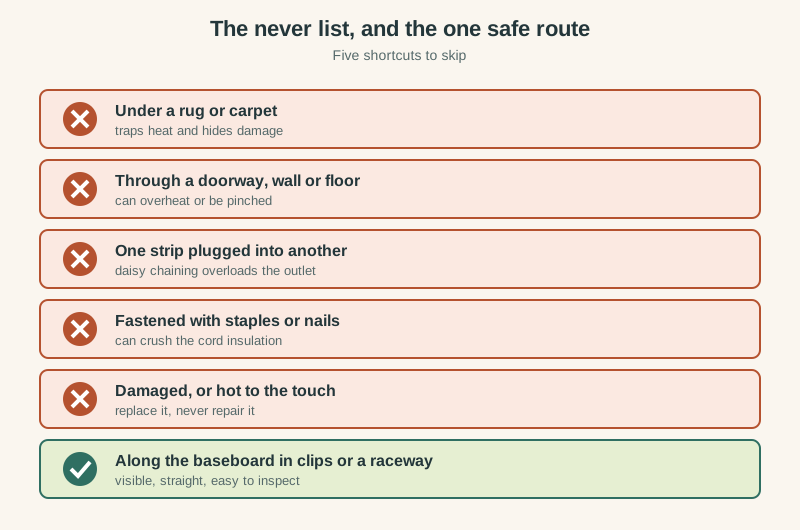
Some shortcuts look neat and are not safe. The Seattle Fire Department says not to run cords under rugs or through high-traffic areas. The University of Tennessee safety office adds that a rug over a cord traps heat and hides damage, and that cords should not be run through walls, doorways, ceilings, windows or floors, where they can overheat or be pinched.
The same office says never to use a damaged extension cord and never to repair one; it should be replaced. The diagram below sums up the list.
11. Pets and Children
FirstEnergy describes chewing on cords as one of the most common electrical hazards for pets and recommends cord protectors, hiding cords behind furniture and bitter-tasting sprays. It also suggests outlet covers for unused outlets.
Lee County Electric Cooperative recommends a heavy plastic sleeve or a bitter-tasting product, and warns that chewing on cords can cause a deadly shock. If a pet touches a cord and shows burns, drooling, coughing or difficulty breathing, contact a vet immediately, and switch the power off before you touch the animal. In homes with toddlers the same ideas work: keep cords behind the console and in a raceway so nothing is loose to pull, put covers on unused outlets and keep the power strip in a vented box that is hard to open.
12. Try This Weekend
- Draw the cord map and unplug every chained strip.
- Buy one power strip with an internal circuit breaker for each outlet you use, and a vented box if you want one.
- Clip the lamp cord to its pole and run the TV cords through one raceway.
- Add a sleeve behind the TV, label the plugs and feel for heat after an evening of use.
Frequently Asked Questions
Can I manage living room cords without drilling?
Yes. Use adhesive clips along the baseboard and console back, a cord raceway for the wall run and ties or sleeves behind the TV. Test each adhesive in a hidden spot first.
Is it safe to hide a power strip in a box?
Only if the box lets heat escape. Choose one with ventilation slots or an open back, and never pile cloth or chargers on the strip.
Can I run a cord under a rug?
No. The Seattle Fire Department advises against running cords under rugs, and the University of Tennessee safety office says a rug traps heat and hides damage to the cord.
How many devices can I plug into one power strip?
Check the maximum rating printed on the strip and stay well below it. Strips suit light loads such as a TV, router and streaming box, and only one should go into each duplex outlet.
How do I stop a dog or cat from chewing cords?
Cover the cords with a heavy plastic sleeve or hide them behind furniture, and consider a bitter-tasting deterrent. If a pet shows burns, drooling, coughing or trouble breathing, call a vet right away.
Will adhesive clips damage my rental walls?
They can lift paint on some surfaces. Test one clip in a hidden area for a day, then peel it slowly and parallel to the wall.
Sources
- Seattle Fire Department, Fire caused by overheated extension cords .
- University of Tennessee Environmental Health and Safety, Electrical Fires on Campus .
- Lee County Electric Cooperative, Keep pets safe from electrical hazards .
- FirstEnergy, Pet-Proofing your Home to Keep Furry Friends Safe around Electricity .
Related Guides
- Small Living Room Storage for Renters: A Layout-First Plan
- Toy Storage in a Small Apartment: A Reachable, Rotating System
- No-Drill Bathroom Storage for Renters: Hooks, Rods and Racks
Image Credits
The cover image is an AI-generated image via ChatGPT, October 2026. The three diagrams are original graphics created for this guide.