A small bedroom usually fails for one reason: storage gets added to a floor that was already full. The room ends up with more containers, a narrower path to the bed, and the same chair covered in clothes. This guide fixes the order. You measure first, protect a walking path, and only then decide what each wall and each height is for.
You need a tape measure, painter’s tape, and about 30 minutes. You do not need to buy anything before step three.
Step 1: Measure the Room and What Is Already in It
Write down the room length and width, the door swing, the window position, and the footprint of the bed and each large piece. A 10 x 9 ft room is only 90 sq ft. A full bed is typically about 54 x 75 in, which covers roughly a third of that floor before anything else comes in. Those are common mattress sizes; measure your own, because frames and headboards add inches.
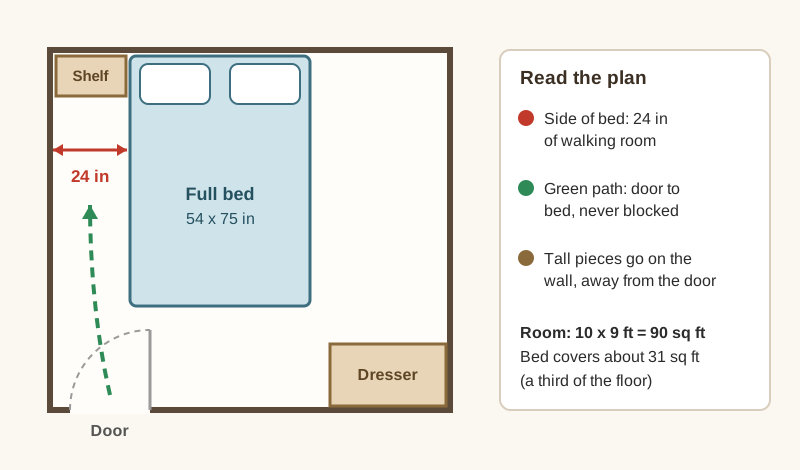
Mark each piece with painter’s tape on the floor, or draw it on paper at 1 inch per foot. Then draw the route from the door to the side of the bed you use. Around 24 inches of clear width on that side is a comfortable target for walking, making the bed and getting up. It is a practical guideline, not a building code, so adjust to your room and your body.
Quick check: if you cannot walk from the door to the bed without turning sideways, remove or relocate one low-use item before doing anything else.
Step 2: Pick Your Case
Most small bedrooms fall into one of these situations. Start with the row that matches yours.
| Your room | The real problem | Best first move |
|---|---|---|
| No closet | Clothes have no home, so they spread to chairs and floors | One tall, narrow clothing unit on the wall farthest from the door, plus hooks |
| Shallow closet | Hanging space works, shelf space does not | Move folded items to drawers or under-bed bins and keep the closet for hanging |
| Queen bed in a small room | The bed leaves one usable side | Treat one side as the walking side and put storage only on the other |
| Shared room | Two sets of daily items in one space | Give each person a reach-height zone of their own, with a shared low-frequency zone |
| Rental, no drilling | Wall storage seems off the table | Freestanding tall units and removable hooks, tested on a small area first |
Step 3: Give Each Height a Job
Floor space is the scarce resource, so the wall does most of the work. Sort what you own by how often you reach for it, then place it by height.
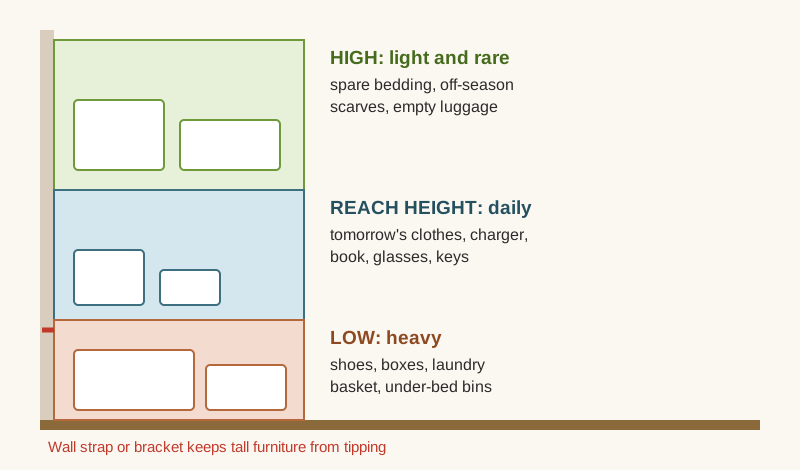
- High: light things you use rarely, such as spare bedding or off-season scarves. Never put heavy items up high.
- Reach height: tomorrow’s clothes, the charger, a book, glasses. This is the zone you touch every day, so keep it small and keep it close to where you use it.
- Low: heavy and bulky items such as shoes, boxes and the laundry basket.
A shallow shelf can replace a bedside table when floor space is tight. Choose a depth that leaves your walking path intact, and check that the shelf does not sit where you will hit your head getting up.
Step 4: Use Under-Bed Space for the Right Things
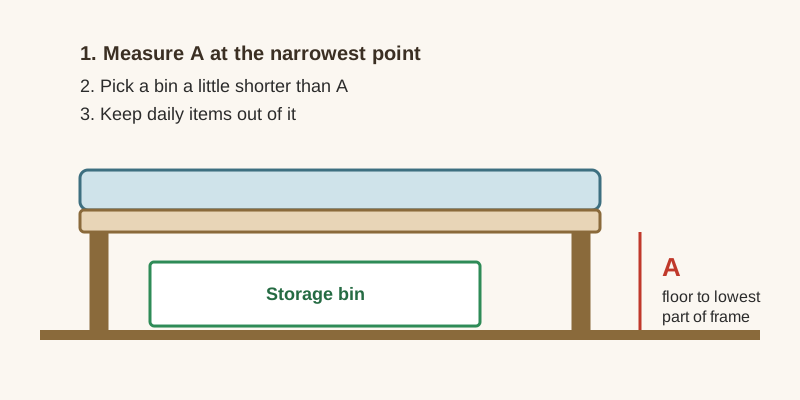
Under-bed storage works for items you need a few times a year: off-season clothes, spare sheets, luggage. It fails for anything daily, because lifting a bin every morning is a habit that does not last.
- Measure the clearance (A in the diagram) from the floor to the lowest part of the frame, at the bed’s narrowest point.
- Choose bins that are a little shorter than that clearance, so they slide without catching.
- Label the end that faces you, and keep one bin per category.
- Leave the head end free if the frame has a headboard brace or cables run there.
If your bed sits flat on the floor, skip this step and use the high and low wall zones instead.
Step 5: Fix the Chair Pile
Clothes land on a chair because the “worn but not dirty” category has no home. Give it one: two wall hooks or one open basket, placed within a step or two of where you take clothes off. Empty it on a fixed day each week. If the pile comes back within days, the home is in the wrong place, so move it closer instead of adding a second one.
Safety Details That Are Easy to Miss
- Anchor tall or top-heavy furniture. The U.S. Consumer Product Safety Commission’s Anchor It! campaign urges anchoring dressers, bookcases and TVs securely to the wall, which matters most where children live or visit.
- Keep alarms and exits clear. Fire-safety guidance from NFPA recommends smoke alarms inside each bedroom and outside each sleeping area, so do not cover or block them with shelves, and do not narrow the route from the bed to the door and window.
- Check your wall type before you drill. Use hardware rated for your wall and the load, and follow the manufacturer’s instructions. Renters should ask before drilling.
Common Mistakes
- Buying storage before measuring, then finding it blocks the path.
- Putting daily items under the bed.
- Filling every wall, which turns the room into a storage closet you sleep in.
- Placing heavy items high or leaving tall furniture unanchored.
- Matching bins to a photo instead of to your measured space.
When This Plan Will Not Be Enough
If the floor is still full after Step 1, the issue is quantity, not organization. Move one piece to another room, sell it, or replace a bulky item with a narrower one. A very small room with a queen bed and no closet may need a different furniture arrangement, not more containers.
Your First 10 Minutes
Tape the bed outline on the floor if you have not, then draw the route from the door to your side of the bed. Walk it. Clear anything on that route and put it in one box. That single change shows you how much of the room you can get back, and the rest of the plan builds on it.
Weekly Reset (5 Minutes)
Empty the chair or hook zone, return the daily-zone items to reach height, and check that the path is still clear. If the path is blocked more than once a week, something in the room has to go.
Frequently Asked Questions
What should I do first in a small bedroom?
Measure the room and the bed, then mark the walking path from the door to the bed. Remove or relocate one low-use item before you buy any storage.
How much space should I leave beside the bed?
Around 24 inches on at least one side is a comfortable target. It is a practical guideline, not a code, so test it with tape and adjust.
What goes under the bed?
Low-frequency items such as off-season clothes, spare bedding and luggage. Keep daily items elsewhere.
How do I stop clothes piling on a chair?
Give them one defined home, two hooks or one open basket, close to where you undress, and empty it weekly.
Do I need to anchor a dresser?
Yes. The U.S. Consumer Product Safety Commission recommends anchoring dressers and bookcases, especially where children live or visit.
Where should the smoke alarm be?
NFPA guidance says inside each bedroom and outside each sleeping area. Do not block it with storage.
Sources
- U.S. Consumer Product Safety Commission (Anchor It! campaign), CPSC Anchor It! Campaign Marks 10 Years, archived snapshot of anchorit.gov, February 12, 2026 (release date July 28, 2025): “Anchor TVs and furniture, such as bookcases and dressers, securely to the wall”
- International Association of Fire Chiefs, Smart choices in smoke alarm placement : NFPA guidance to install smoke alarms inside each bedroom and outside each sleeping area
Related Guides
- Under-Bed Storage for a Small Bedroom: A Measured 48-Inch Clearance
- Small Bedroom Storage Ideas: DIY Pull-Out Drawers
- Small Closet Organization Ideas
- Renter-Friendly Closet Organization With Adhesive Hooks
Image Credits
The three diagrams and the cover in this guide are original illustrations drawn for this article. Measurements are typical examples; measure your own room.