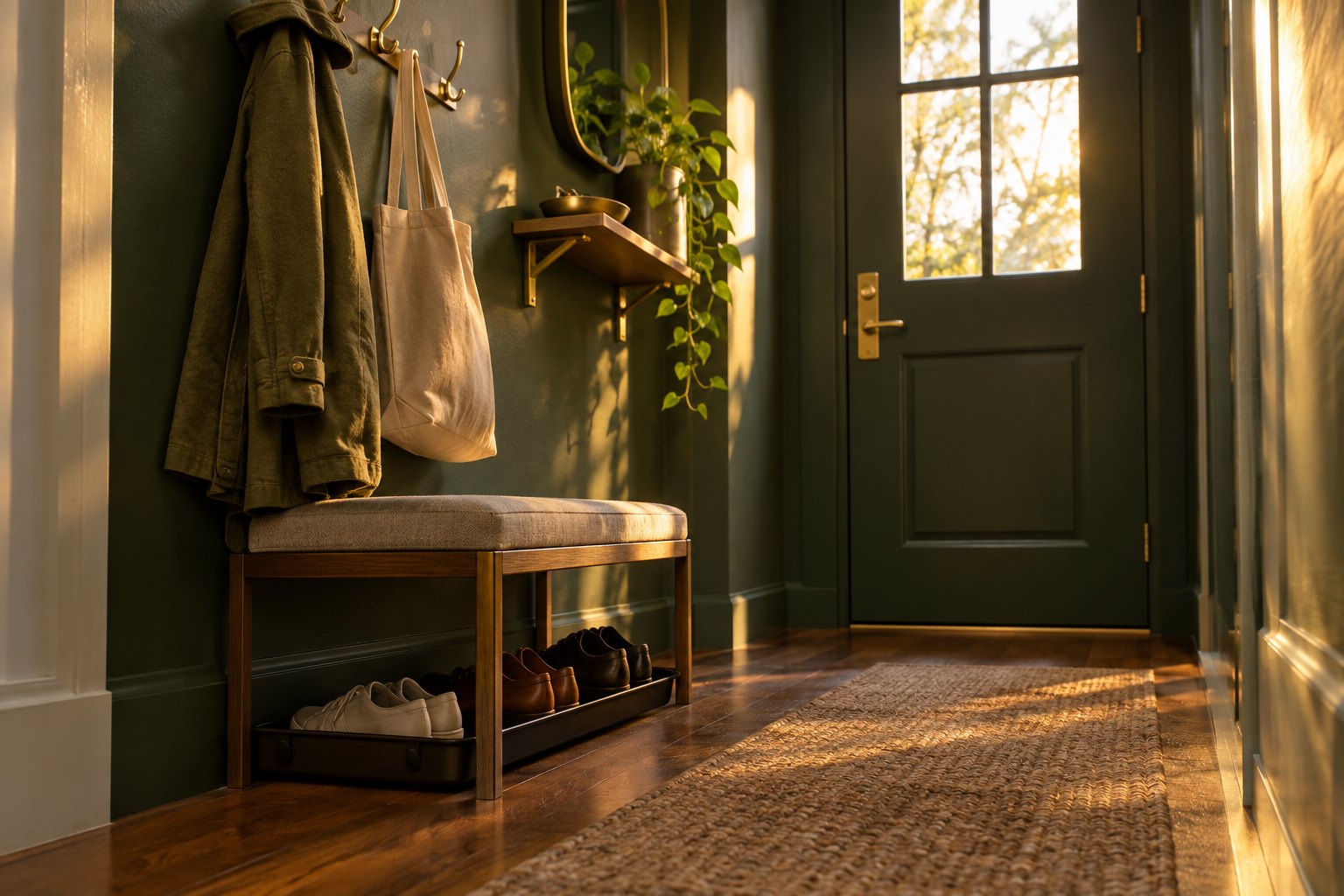
In a three-foot-wide hallway, every piece of storage is paid for in width. A hook rail, a shoe shelf and a coat hanging from a hook all take something from the same 36 inches, and the hallway still has to work for a person carrying groceries or a laundry basket. So the useful question is not what storage you can buy. It is how much width you can spend, and where.
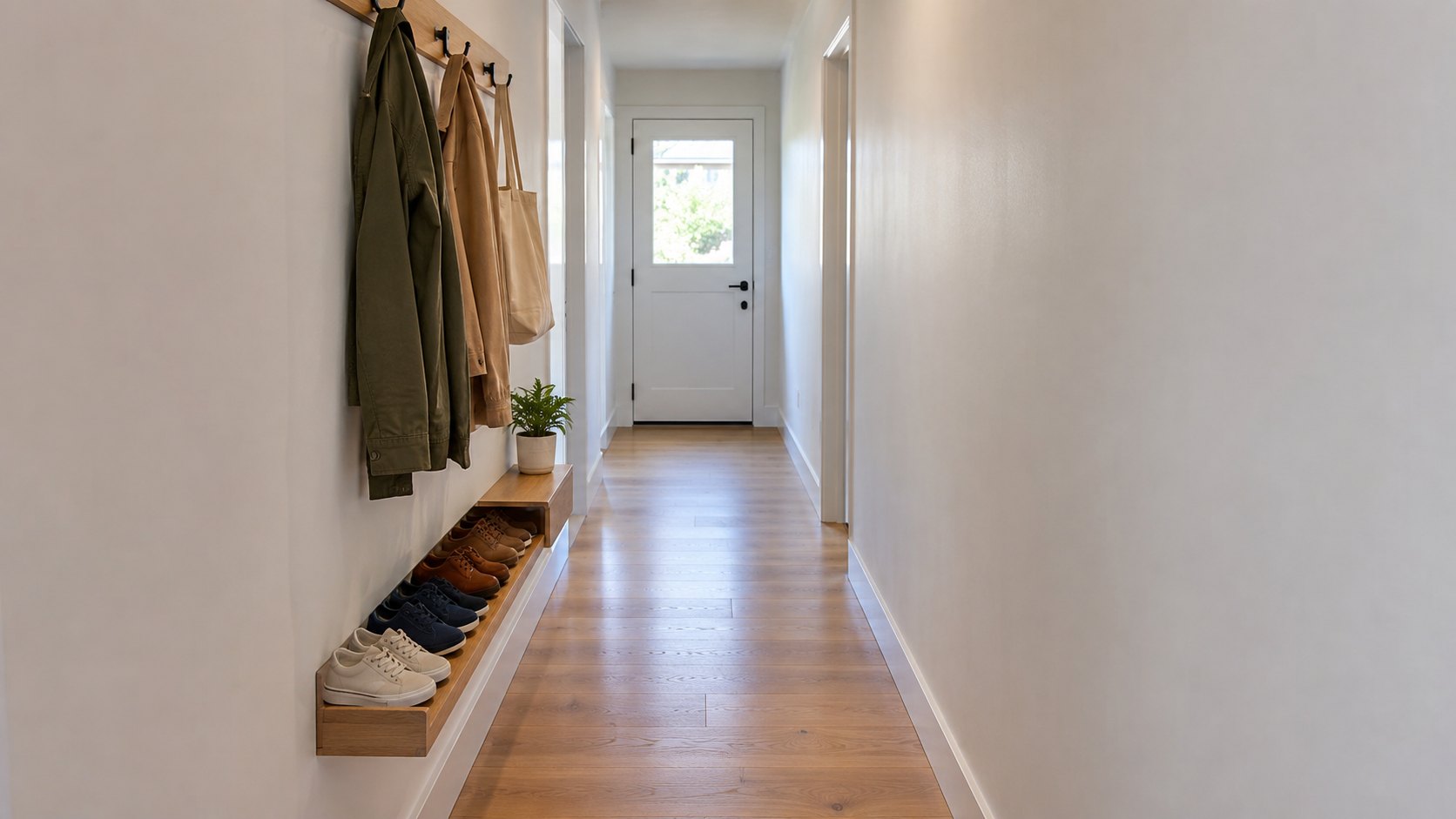
The cover photo shows the idea: one wall carries a slim hook rail with two coats and a bag plus a shallow shoe shelf, and the opposite wall stays bare. This guide shows how to measure the width at three heights, compare it with a few well-known numbers, set a budget for wall depth and test the plan before you drill. For the rest of the entrance, see our narrow entryway drop-zone guide .
1. Measure the Width at Three Heights
A hallway does not have one width. Baseboards narrow it at the floor, door casings narrow it at the sides, and coats narrow it at shoulder height. Measure wall to wall at three heights:
- Floor level, just above the baseboard, where shoes and shelves sit.
- Hip height, about 36 inches up, where door handles and bags sit.
- Shoulder height, about 55 inches up, where hanging coats sit.
The smallest of the three is your clear width. Also write down the usable wall length between doors, the ceiling height and the position of switches, vents and radiators. Then note the swing of every door that opens into the hallway, because a swinging door can take more space than a shelf.
2. Know the Comparison Numbers
Three published numbers make good yardsticks. None of them is a rule for storage you add to your own home, but they give you something concrete to test against:
- 36 inches. The International Residential Code sets the minimum width of a new residential hallway at 3 feet. The ADA Standards also use 36 inches as the clear width of a walking surface.
- 32 inches for 24 inches. The ADA Standards allow a walking surface to narrow to 32 inches for a length of 24 inches at most, if the narrow spots are separated by at least 48 inches of full 36-inch width.
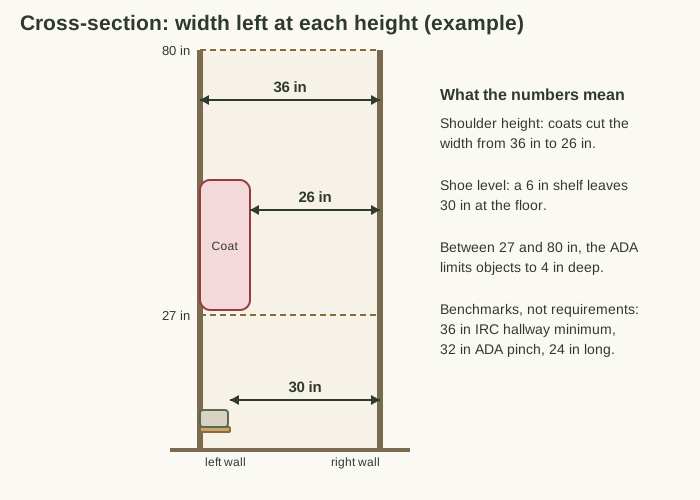
- 4 inches. The ADA Standards limit objects with leading edges between 27 and 80 inches above the floor to 4 inches deep. Objects below 27 inches or above 80 inches can stick out further, because a cane can detect the low ones and the high ones clear your head.
Read together, they suggest a simple plan for a 36-inch hallway: keep anything above 27 inches shallow, keep any narrowed run short, and keep full width on both sides of it.
3. Build the Width Budget
Subtract the depth of each item from the width you measured. Use your own numbers, but this example uses a 36-inch hallway:
| Item | How far it sticks out | Width left |
|---|---|---|
| Hook rail with hooks only | about 4 inches | 32 inches |
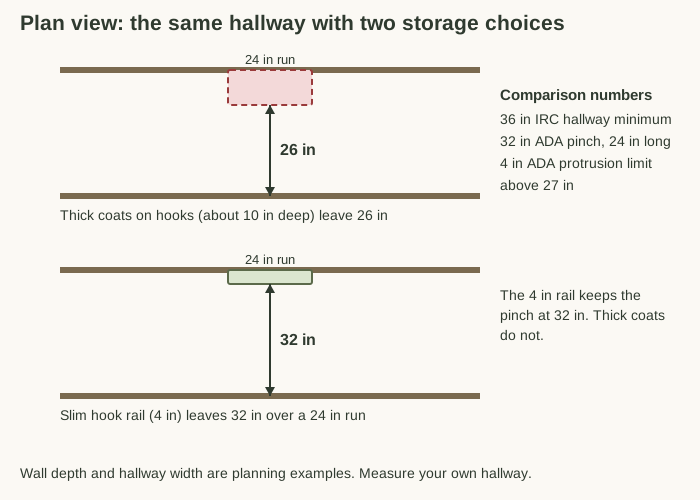
| Thick coat on a hook | about 10 inches (measure yours) | 26 inches |
| Shoe shelf at floor level | 6 inches | 30 inches |
| Hook rail with a thick coat, plus shoe shelf | 10 inches at shoulder height, 6 inches at the floor | 26 inches at the narrowest |
The surprise is the coat. The hook may stick out 4 inches, but a puffy coat hanging from it can reach 10 inches or more. Hang your thickest coat on a hook position and measure from the wall to the outside of the coat before you decide on a rail.
4. Choose Where the Narrow Spot Goes
If you accept a narrower spot, make it a short one in the right place:
- Keep the storage run to about 24 inches long, which is the length of narrowing the ADA exception allows.
- Leave at least 48 inches of full-width hallway on each side if the hallway is long enough. In a short hallway, place the run next to the entrance, where people already stop.
- Keep it away from door swings and from the spot where two doors face each other.
- Put it on one wall only. Storage on both walls turns a hallway into a corridor you have to turn sideways in.
The diagram shows the same 36-inch hallway at three heights, so you can see which item sets the narrowest width.
5. Use Height Before Depth
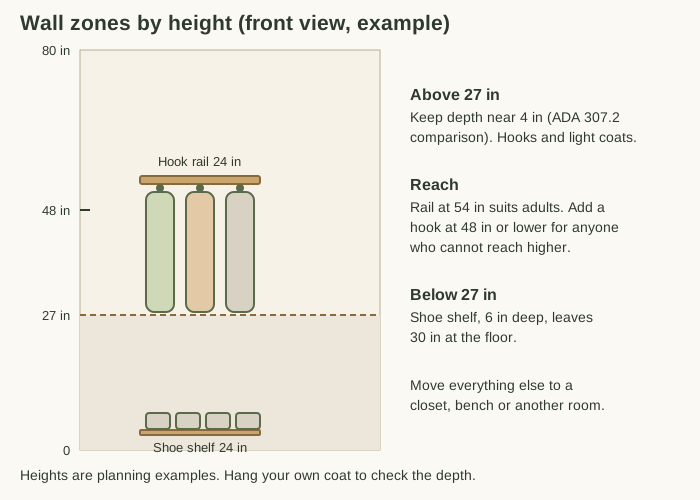
The wall above the shoe shelf is the cheapest place to find space, because a flat hook costs very little width. Use these zones:
- Below 27 inches: shoes on a low, shallow shelf.
- 27 to 48 inches: one low hook for a child or for anyone who cannot reach higher, plus a small tray or hook for keys.
- About 54 inches: the main hook rail, 24 inches long, with three hooks.
- Above 80 inches: a shelf for rarely used items, if you can reach it safely.
The ADA guidance gives an unobstructed forward reach range of 15 to 48 inches above the floor. A rail at 54 inches suits many adults, so add one hook at 48 inches or lower. Light items, such as hats or a tote bag, belong on the upper hooks, and heavy items go low.
6. Decide What Stays in the Hallway
A hallway cannot hold the household wardrobe. Sort what you own into three groups:
| Zone | What stays | What moves elsewhere |
|---|---|---|
| Coats | Two or three current-season coats | Off-season and rarely worn coats |
| Shoes | Three or four everyday pairs | Seasonal and occasional pairs |
| Bags and keys | One or two daily bags, keys | Extra bags, spare keys, mail |
Move the rest to a closet, a bench near the door or a box under a bed. Our small closet guide covers the closet side, and the 350 square foot apartment guide shows where reserve items can go in a studio. If several people share the hallway, give each person a hook and share a single shoe zone.
7. Test Before You Drill
Test the plan with tape and temporary hooks:
- Tape a line on the floor showing the depth of the shoe shelf.
- Stick a temporary adhesive hook at the planned height and hang your thickest coat.
- Measure the clear width at floor, hip and shoulder height.
- Walk the hallway with arms full, then open each nearby door.
- Leave everything in place for three days and see what you bump.
If the hallway feels tight, shorten the rail, choose a thinner coat for the hook or move the shoes to another spot. Changing a tape line costs nothing, and changing a drilled shelf costs a patch and a coat of paint.
8. Mount It Safely
Attach rails and shelves to studs, or use anchors rated for the weight, and remember that a full coat rail carries more than it looks like it does. If you rent, ask your landlord before you drill and consider an adhesive system rated for the load. Keep heavy items low, never hang a coat where it covers a switch or blocks a door, and check the mounting once a season.
9. Common Mistakes in a Narrow Hallway
- Measuring only the hook. The coat is deeper than the hook.
- Measuring at one height. The narrowest point is rarely at hip height.
- Putting storage on both walls. One wall only.
- Storing every coat and every pair of shoes in the hallway. Keep only what you wear this season.
- Placing storage in a door swing. Test every door.
- Buying a deeper unit because the wall is empty. Empty wall is not free width.
10. A Five-Minute Weekly Reset
Once a week, put every coat, bag and pair of shoes back in its place and take away anything that does not belong. At the change of season, swap the coats on the rail with the ones in the closet. If the hooks are crowded, remove one item instead of adding a second row.
11. Try This Weekend
Measure the width at the floor, at hip height and at shoulder height. Tape the shoe shelf depth on the floor, hang your thickest coat on a temporary hook and walk the hallway with a bag in each hand. If you still have at least 30 inches, keep the plan. If not, shorten the rail or move the shoes before you drill.
Frequently Asked Questions
Can a 3-foot hallway really hold coats and shoes?
Yes, if the narrowing is short and shallow. A slim hook rail that sticks out about 4 inches over a 24-inch run leaves 32 inches of a 36-inch hallway, and a low shoe shelf leaves 30 inches at floor level. Measure your own hallway first, because a thick coat on a hook can add 10 inches.
How deep can hallway storage be?
Every inch of storage depth is an inch of width you lose. The ADA Standards limit objects between 27 and 80 inches above the floor to 4 inches deep, which is a useful comparison for hooks and rails. Below 27 inches, such as a shoe shelf, you can go deeper, but a 6-inch shelf still leaves only 30 inches at the floor.
What is the minimum width for a hallway?
The International Residential Code sets the minimum width of a new residential hallway at 3 feet, and the ADA Standards use 36 inches as the clear width of a walking surface. These rules apply to new construction and specific buildings, not to storage you add to your own hallway, but 36 inches is the number to protect.
How high should coat hooks be?
The ADA guidance gives an unobstructed forward reach range of 15 to 48 inches above the floor. A rail around 54 inches suits many adults, so add one hook at 48 inches or lower for children or anyone who cannot reach higher.
Where should shoes go if the hallway is too narrow?
Move them to the end of the hallway near the door, to a bench or a closet, or keep only three or four everyday pairs on a shallow low shelf. Storing the rest elsewhere matters more than finding a slimmer shelf.
How do I keep a narrow hallway organized?
Give coats, shoes, bags and keys fixed places, keep only two or three current coats in the hallway and do a five-minute reset each week. If the hooks fill up, remove something instead of adding a second row.
Sources
- US Access Board, ADA Standards for Accessible Design : the 36-inch clear width of walking surfaces with the 32-inch exception for 24 inches (403.5.1) and the 4-inch protrusion limit between 27 and 80 inches (307.2).
- US Access Board, ADA Guide: Protruding Objects : why objects below 27 inches or above 80 inches can protrude further.
- US Access Board, ADA Chapter 3: Operable Parts : the 15 to 48 inch unobstructed forward reach range.
- Building Code Trainer, Minimum Hallway Width : the 3-foot minimum hallway width in Section R311.6 of the 2021 International Residential Code.
The diagrams are original illustrations made for this guide. The ADA Standards apply to specific buildings and the IRC to new residential construction, so they are used here only as comparison numbers. Widths, depths and heights are planning examples, so measure your own hallway and follow the manufacturer’s instructions for hooks, shelves and anchors.
Image Credits
- Cover: AI-generated image via ChatGPT, October 2026.