A bathroom with no storage closet still has to hold the products that do the dirtiest work: toilet bowl cleaner, an all-purpose spray, a scrub brush and a stack of cloths. In a small apartment they usually end up under the sink, on the tank or on the floor beside the toilet, which are the easiest places for a child or a pet to reach.
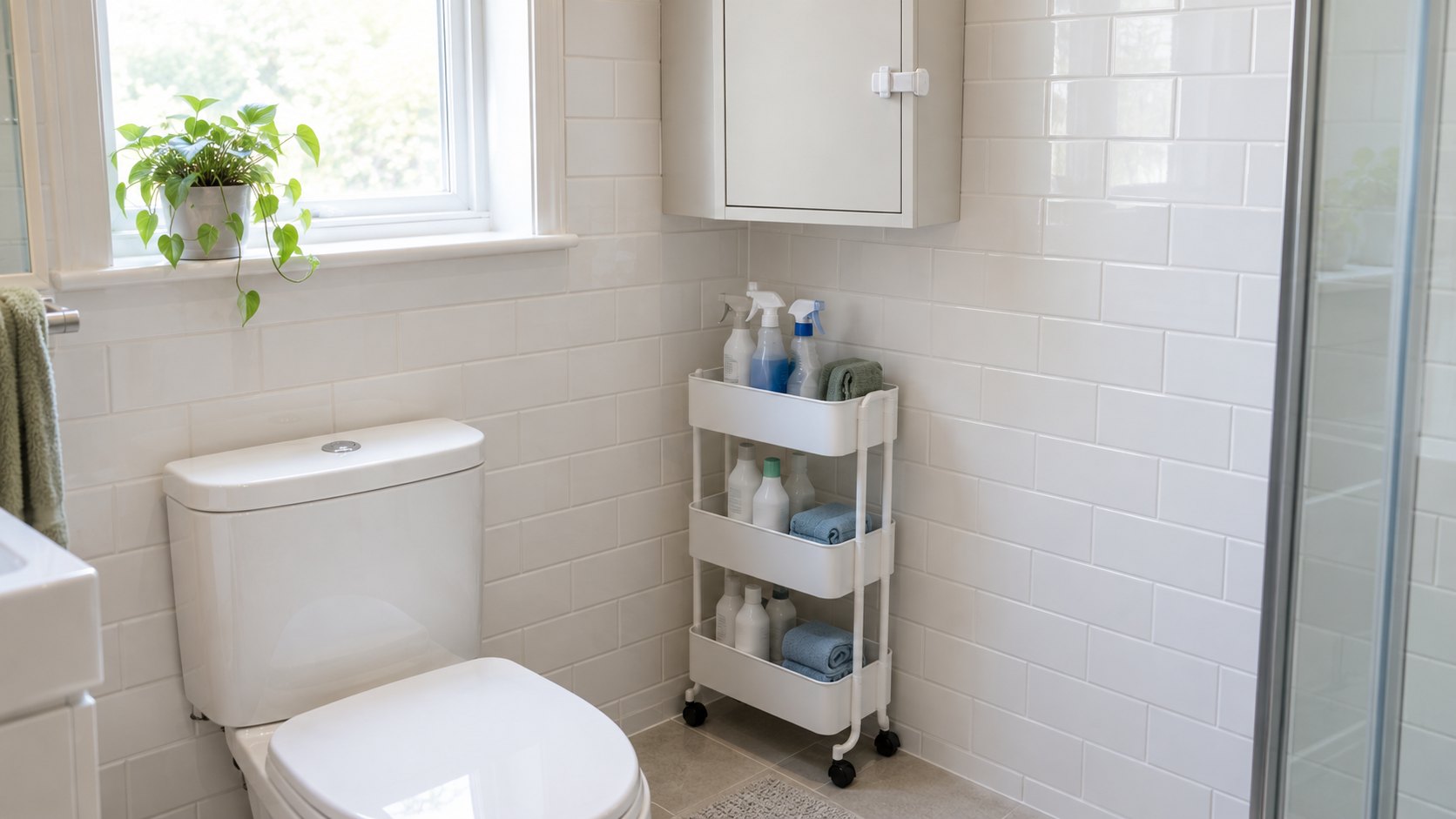
This guide builds a compact, safe setup around the layout in the cover photo: one locked wall cabinet and one slim rolling cart. It starts with the safety rule, then covers where to put the cabinet, how to separate products that must never meet, and what to keep on the cart. If your problem is general bathroom storage rather than cleaning products, start with our Small Bathroom Organization Ideas: A Zone-by-Zone Plan instead.
1. Start With Who Lives in the Home
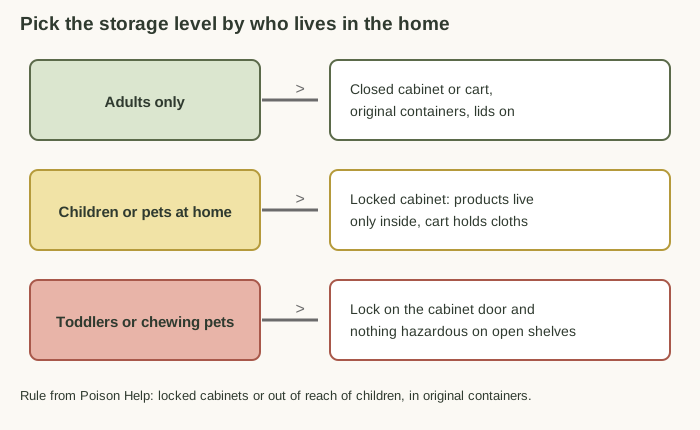
The right storage depends on who can reach it. Use three levels:
- Adults only: a closed cabinet or a cart is enough, as long as products stay in their original containers with the lids on.
- Children or pets at home: products live inside a locked cabinet, and the cart holds only cloths and tools.
- Toddlers or chewing pets: add a lock to the cabinet door and keep nothing hazardous on open shelves, in the tub or on the floor.
Guests count too. A friend’s child visiting for an afternoon will find the open cart before you notice.
2. Follow the Core Rule: Locked or Out of Reach
Poison Help, the US national poison control service, advises keeping all household cleaners and other potentially poisonous substances in locked cabinets or out of the reach of children. Indiana’s environmental agency gives the same rule and adds pets, and it says to return products to safe storage immediately after use. A product left on the tub edge “for a minute” is the usual way an accident starts.
In practice, that means a lock does the safety work, not the height. A high shelf helps, but a stool or a determined climber changes that quickly. A latch or lock costs little and is the part of the setup that matters most.
3. Choose the Cabinet Spot
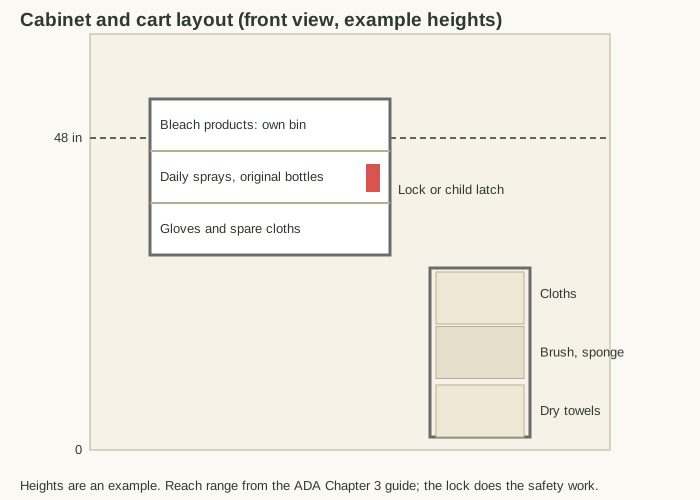
With no closet, the cheapest safe spot is a wall cabinet. The cover photo shows one above the toilet with a child-safety latch on the door. Use these checks:
- Reachable by you. The ADA Chapter 3 guide uses a 15 to 48 inch unobstructed reach range. Keep the shelf you use most below 48 inches, or you will start leaving bottles out because lifting them is a chore.
- Strongly fixed. Cleaning bottles are heavy. Fasten the cabinet to wall studs or use anchors rated for the load, and never rely on adhesive for a loaded cabinet. If your lease forbids drilling, a freestanding tall narrow cabinet works the same way, as long as you anchor it to the wall to prevent tipping.
- Away from heat and sun. The Indiana guide says to store products out of the sun, tightly sealed and away from heat, sparks and flames.
- Not near food. Never store hazardous products in the same area as food.
4. Keep Products in Their Original Containers
Poison Help and the Indiana guide agree: leave cleaners in the container they came in. The label tells you what the product is, how to use it and what to do after contact. Never pour a cleaner into a food or drink container such as a cup or bottle.
If a product must go into another container, such as a spray bottle you refill, label it with the product name and the date you first stored it there, and make sure the container is child-resistant. If you cannot do both, keep the original.
5. Keep Incompatible Products Apart
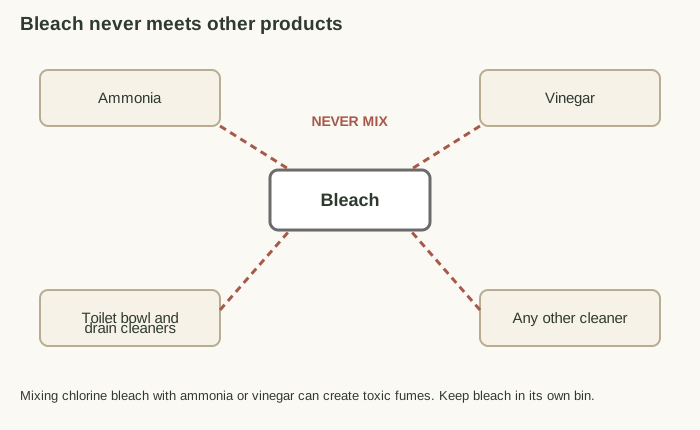
The most dangerous mistakes happen when two products meet. Indiana’s guide says mixing chlorine bleach with ammonia or vinegar can create toxic fumes, and Poison Help says bleach should not be mixed with anything other than water. That includes toilet bowl cleaners and drain cleaners, which often contain other chemicals.
Storage can prevent the mix. Give bleach its own bin on its own shelf, away from ammonia products and acid-based cleaners. Never combine two products in the same bucket, even if the labels both say they clean the same thing. One product per task, one rinse between tasks.
6. Use the Cart for Cloths and Tools, Not for Bottles
The slim rolling cart in the cover photo is useful, but its trays are open. In a home with children or pets, put the bottles in the locked cabinet and use the cart for what is safe to leave out: microfiber cloths, a scrub brush, a sponge and dry towels. In an adult-only home, you can keep a spray bottle on the cart, as long as it stays in its original container and lids stay on.
Put the cart where it does not block the toilet or the door. Wheels let you pull it out for cleaning day and park it against the wall the rest of the week.
7. Ventilate While You Clean
Storage is half of the system; the other half is use. The CDC advises turning on fans and opening windows when using household cleaners and chemicals, and returning products to a child-proof cabinet when you finish. Build that into the routine: open the window, run the fan, clean, rinse, return everything to the cabinet, then close the lock. A cleaning kit that returns to its place in one minute is a kit that stays safe.
8. Keep the Poison Help Number Handy
Save the Poison Help line, 1-800-222-1222, in your phone, and write it on a label inside the cabinet door. If someone swallows a cleaning product or breathes in fumes, call right away. If the person has collapsed, is having trouble breathing or has a seizure, call 911 instead. This is the safest use of a label you will make this year.
9. Trim the Stash
Fewer products mean less to store and fewer chances to mix. For a small bathroom, a basic kit is often enough: a toilet bowl cleaner, an all-purpose bathroom spray, a scrub brush and a few cloths. Read the labels, finish what you have and avoid keeping duplicates.
For leftovers you no longer want, do not pour them down the drain or onto the ground. The Indiana agency and university extension guides advise using your local household hazardous waste program, so check your city or county site for drop-off dates.
10. Common Mistakes in a Bathroom With No Storage Closet
- Storing cleaners under the sink with no lock. It is the first cabinet a toddler opens.
- Keeping bottles on the tank or the tub edge. Out of the cabinet means within reach.
- Mixing products to save time. Bleach with ammonia or vinegar creates toxic fumes.
- Decanting into a cup or bottle. An unlabeled container gives no warning.
- Hanging the cabinet without anchors. A full cabinet is heavy.
- Forgetting the phone number. Add it before you need it.
11. Try This Weekend
- Take everything out from under the sink, off the tank and from the floor.
- Throw away empty and duplicate products, and take unwanted leftovers to a household hazardous waste drop-off.
- Mount a wall cabinet (or anchor a narrow cabinet) with a lock or child-safety latch.
- Put bleach in its own bin on its own shelf, and keep the other products in their original containers.
- Set the cart beside the cabinet with cloths, a brush and a sponge only.
- Save 1-800-222-1222 in your phone and tape it inside the cabinet door.
For the rest of the bathroom, see our renter-friendly bathroom storage guide , and for the cabinet under the sink, see under-sink organization . If your laundry products are the problem, our small laundry room guide covers locking them up too.
Frequently Asked Questions
Where should I store cleaning supplies in a small bathroom?
Use a locked wall cabinet or an anchored narrow cabinet with a child-safety latch, and keep products in their original containers. Use a rolling cart for cloths and tools, not for bottles, if children or pets live in the home.
Is it safe to store cleaning products under the sink?
Only with a working child lock on the cabinet door. Poison Help advises keeping household cleaners in locked cabinets or out of the reach of children, and an unlocked low cabinet is easy for a toddler to open.
Can I put a cleaning product in a different bottle?
Keep it in the original container whenever you can. If you must transfer it, label the new container with the product name and the date, make sure it is child-resistant and never use a food or drink container.
Which cleaning products should never be mixed?
Never mix chlorine bleach with ammonia or vinegar, because the mix can create toxic fumes. Poison Help advises that bleach should not be mixed with anything other than water, including toilet bowl and drain cleaners.
Do I need a locked cabinet if I have no children?
Not always, but pets and visiting children are reasons to lock it anyway. At minimum, keep products in their original containers with the lids on, in a closed cabinet away from food and heat.
What should I do if someone is exposed to a cleaning product?
Call Poison Help at 1-800-222-1222 right away. If the person has collapsed, is having trouble breathing or has a seizure, call 911 instead.
Sources
- US Health Resources and Services Administration, Poison Help prevention tips (archived copy) : keep household cleaners in locked cabinets or out of reach of children, in original containers, never in food containers, and bleach should not be mixed with anything but water.
- Indiana Department of Environmental Management, Safe Storage and Use of Hazardous Household Products : store out of reach of children and pets, return products after use, label transferred containers with name and date, and do not mix bleach with ammonia or vinegar.
- Montana State University Extension, Hazardous Household Products (PDF) : store products in their original packaging in a locked cabinet out of reach of children, and never mix bleach and ammonia.
- US Centers for Disease Control and Prevention, Protecting Yourself and Your Family Against Poisonings (PDF) : turn on fans and open windows when using household cleaners, return products to childproof cabinets and know how to reach a poison control center.
- US Access Board, ADA Chapter 3: Operable Parts : the 15 to 48 inch unobstructed reach range.
Related Guides
- No-Drill Bathroom Storage for Renters: Hooks, Rods and Racks
- Small Bathroom Organization Ideas: A Zone-by-Zone Plan
- Under-Sink Organization Ideas: A Measured, Leak-Aware System
Image Credits
The cover image is an AI-generated image via ChatGPT, October 2026. The three diagrams are original graphics created for this guide.