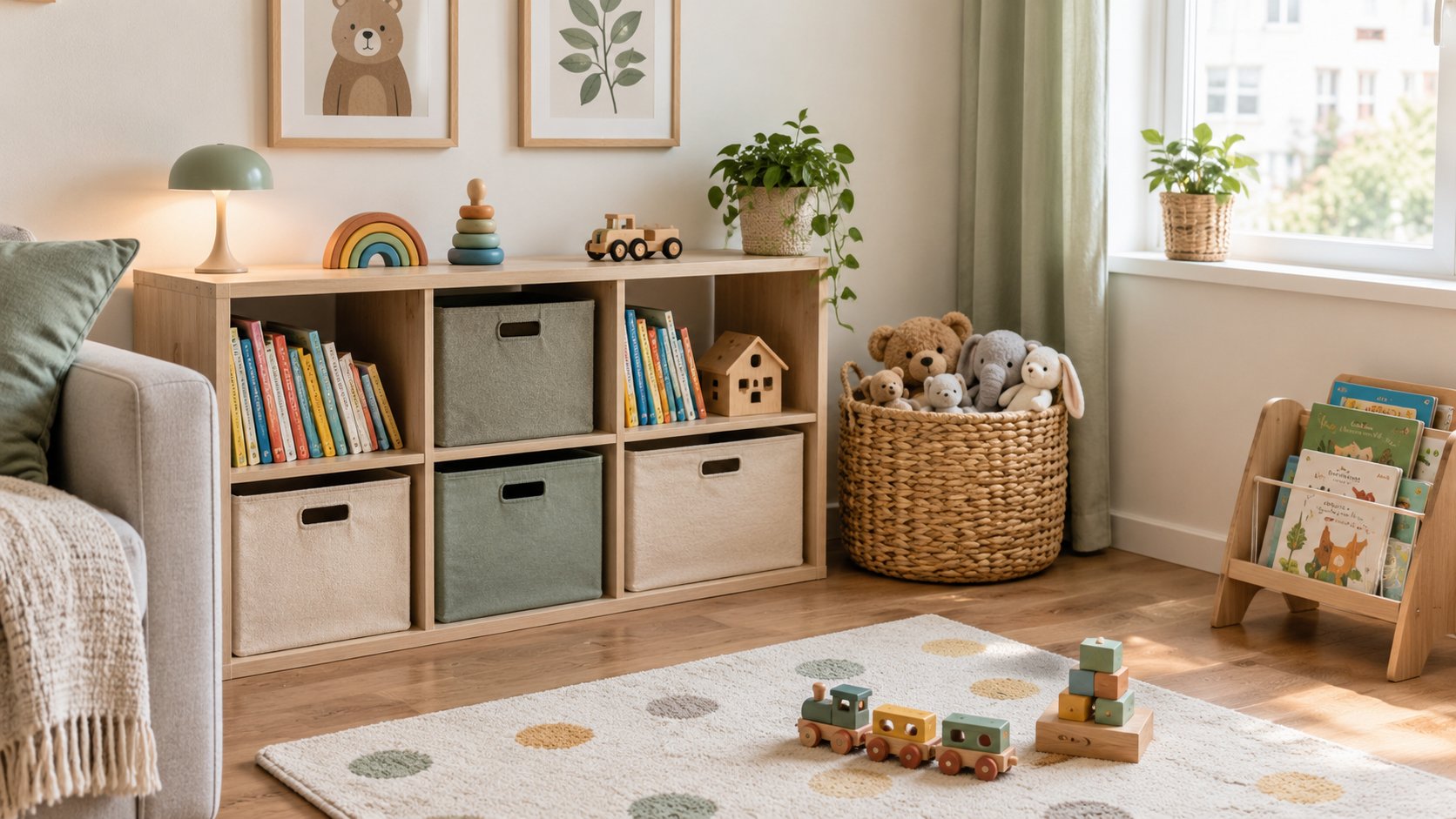
Quick answer: keep one low, anchored shelf with open bins at child height, keep only a small set of toys out, store the rest in a closed bin that rotates in, give soft toys and books their own home, and finish each day with a short reset the child can help with.
Why Toys Take Over Small Apartments
Toys arrive faster than they leave. Gifts, hand-me-downs, party favors and impulse purchases all add up, and in a small apartment every toy lives in the same rooms as the sofa, the dining table and the walkway. Without a plan, they end up in piles in the most-used corners.
The usual answer is a bigger box. A big box hides the problem for a day and then creates a new one: everything is mixed together, nothing is easy to find, and the child tips the whole thing out to look for one piece. This guide takes a different approach: reduce what is out, put it where a child can reach it, and give each category an obvious home.
Fewer Toys Out Can Mean Better Play
A small laboratory study at the University of Toledo compared toddlers playing in a room with four toys and in a room with sixteen. According to the university’s summary, children with fewer toys played about twice as long with the toys they had and in more varied ways. Science News reported the same pattern: in the sixteen-toy room the children played with more toys but spent less time with each.
Treat this as encouragement, not a rule. It was a small lab study with toddlers, the researchers note that it does not pinpoint an ideal number of toys, and a lab room is not your living room. Still, the practical takeaway is useful: a smaller visible set is easier to tidy, easier to choose from and easier to store.
Build a Simple Toy Rotation
A rotation has three places. Out now is a small set on the low shelf that the child can reach today. Next up is a closed bin in a closet, ready to swap in. Archive is everything rarely used or outgrown, stored higher up where only adults reach.
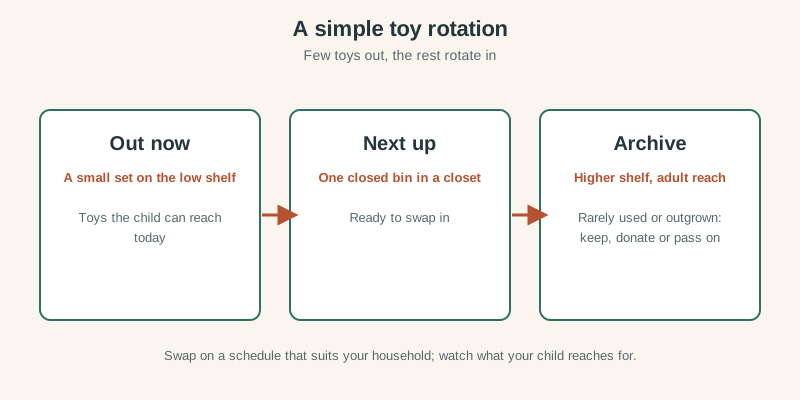
Swap on a schedule that suits your household. Every week or two is a reasonable place to start, but let your child guide you. If a toy is ignored for several swaps, it is a candidate for the archive or for donation; if a toy is asked for by name, bring it back.
A rotation also makes gifts easier to handle. New toys go into the next-up bin first, so they arrive as a small surprise instead of an extra pile on the floor.
Put Storage Where Children Can Reach It
Storage that only an adult can reach means an adult has to do every cleanup. The ADA Standards include advisory reach ranges for children: 20 to 36 inches for ages 3 and 4, 18 to 40 inches for ages 5 to 8, and 16 to 44 inches for ages 9 to 12. They are advisory rather than mandatory, but they are a handy guide for placing toys.
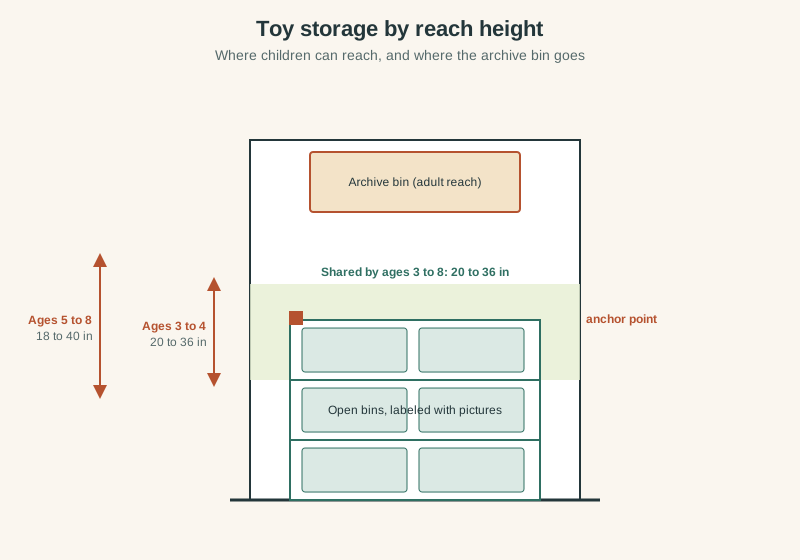
The overlap is useful: storage between 20 and 36 inches high works for both the 3 to 4 and the 5 to 8 age groups. Put daily toys in that band, heavier or rarely used items on the bottom row, and the archive bin out of reach.
Choose One Low Shelf and Anchor It
A low cube shelf is the workhorse of a small-space toy system. It holds bins in a tidy grid, its top works as a display ledge for a few favorite items, and it takes up little floor space. Choose one with a depth that fits your walking path, and measure before you buy.
Anchor it. The U.S. Consumer Product Safety Commission’s Anchor It! campaign focuses on TVs and furniture that can tip over and injure children, and its guidance covers furniture such as bookcases and dressers. A cube shelf is similar, so follow the same logic: anchor it to the wall where you can, and use the hardware and instructions that come with the product.
If you rent, ask your landlord what is permitted, ideally in writing. Anchor kits use small fasteners, and some landlords allow them. If anchoring truly is not an option, choose a low and stable unit, keep it against the wall, and avoid stacking items on top that a child might try to climb for.
Use Open Bins and Pictures, Not One Big Box
Sort toys by category: blocks, vehicles, art supplies, dolls and figures, puzzles and games. Give each category one open bin. Open bins are easy for small hands, and they avoid heavy lids that can pinch fingers or slam.
For children who cannot read yet, label bins with a photo or drawing of what belongs inside. Pictures turn cleanup into a matching game and let the child take ownership of the system.
Keep each bin small enough that it does not become a second pile. When a bin is full, the answer is to edit what is inside, not to buy a bigger bin.
Keep Small Parts Away From Little Ones
If your household has children of different ages, storage has a safety layer as well as a tidiness layer. The Toy Association advises avoiding toys with small parts for children under three and for children who mouth objects, and keeping a separate toy chest for an older child’s toys that contain small parts.
In practice, that means the low open shelf is for toys that are safe for the youngest child. Toys with small pieces, such as building sets, beads or craft supplies, go in a higher or closed container, used together with an adult or at a table. The Toy Association also recommends inspecting toys regularly and repairing or replacing damaged parts, which is a good reason to check bins at each rotation.
Give Soft Toys, Books and Big Items Their Own Home
Soft toys are the most volume-hungry category. One generous basket near the play area holds them and signals that this is their place. A basket also makes them easy to toss back, which suits the way children actually tidy.
Books work best displayed with their covers showing, because children choose by picture. A small front-facing book rack, or one shelf of the cube unit, is enough. Keep a few books out and rotate the rest like toys.
Big items, such as a ride-on toy or a play kitchen, need their own decision. Ask whether the item earns its floor space. If it does, give it a fixed spot against a wall. If it does not, it may belong in the archive.
Plan the Play Corner
Choose one corner of a shared room and make it the toy zone. Put the shelf and basket on one wall, a rug in front so play stays contained, and keep the walking path clear on the other side.
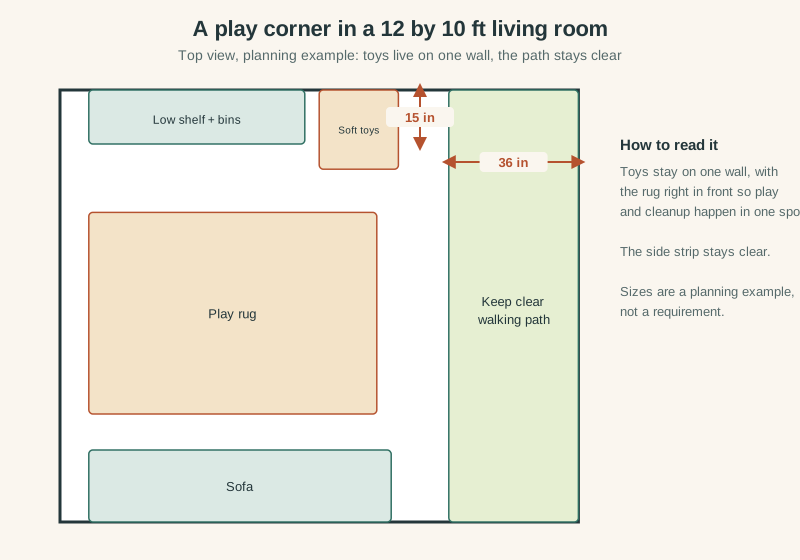
The 36-inch clear path in the plan comes from the ADA Standards, which set that figure as the minimum clear width of an accessible walking surface. A private home does not have to meet it, but it is a sensible target, and it matters even more when small toys might end up underfoot. Our small living room storage guide explains how to protect that path while adding storage.
A rug also helps with cleanup. When play happens on the rug, you know where to look for stray pieces.
Keep Daily Storage Separate From Reserve Storage
Toys that are not in rotation do not belong in the living room. Put the next-up bin and the archive in a closet or under a bed, and label them so that anyone in the household can find what is inside. If closet space is tight, our renter-friendly closet organization guide and small bedroom storage ideas show where to find it.
Seasonal items, outgrown toys and duplicates are the first candidates for the archive. If an outgrown toy has no emotional value, pass it on while it is still in good condition.
A Ten-Minute Reset Children Can Help With
A system lasts only when upkeep is small. Try a short reset at the end of the day: set a timer, gather everything into the basket, then sort bin by bin, then wipe the rug and shelf top. Keep the steps in the same order every day, so children learn the pattern.
Make it a joint job. Younger children can match pictures and drop soft toys into the basket, while older children can sort by category. Praise effort rather than perfection, and stop when the timer rings.
If a particular toy keeps ending up on the floor, ask why. Perhaps its bin is too high, too full or too far from where it is used. Move the bin, not the child.
Handle Gifts and Holidays Without Losing Control
Gifts are the largest source of surprise volume. Agree on a simple rule with family: one new toy in, one old toy out, or new gifts go to the next-up bin first. Before birthdays and holidays, do a quick edit of the archive so there is room.
You can also steer gifts toward items that take little space, such as books, art supplies or experiences. A short list shared with relatives makes this easier than correcting after the fact.
When Clutter Comes Back, Change the System
If piles reappear, do not simply tidy them again. Check each step: is the shelf low enough, are bins small enough, is the set out too large, is the rotation overdue? Make one change at a time and watch for a few days.
A toy system is never finished, because children’s interests and ages keep changing. The goal is not a perfect room, but a room where cleanup is quick, play is easy, and the walking path stays clear.
Frequently Asked Questions
How many toys should be out at once?
There is no proven ideal number. A small laboratory study compared four toys with sixteen for toddlers and found longer, more varied play with four, but its authors did not pinpoint an optimal count. Start with a set that fits one shelf or a few bins, then adjust by watching what your child actually uses.
How do I store toys in a small apartment with no playroom?
Use one corner of a shared room: a low shelf with open bins, a basket for soft toys, a rug for play, and one closed bin higher up for toys that are out of rotation.
Should I anchor a low toy shelf?
Where you can. Safety guidance from the U.S. Consumer Product Safety Commission covers anchoring TVs and furniture such as bookcases and dressers, and a cube shelf is similar. Ask your landlord what is allowed and follow the product instructions.
What height should kids’ toy storage be?
Within children’s reach. The ADA Standards give advisory reach ranges of 20 to 36 inches for ages 3 and 4 and 18 to 40 inches for ages 5 to 8, so storage between 20 and 36 inches works for both.
How do I keep small parts away from toddlers?
Avoid toys with small parts for children under three and for children who mouth objects, and keep a separate container for an older child’s toys that contain small parts.
How often should I rotate toys?
There is no fixed rule. Try a swap every week or two, and let your child’s interest guide you: bring back favorites, retire what is ignored.
Related Small-Space Guides
For more ways to make room in a small home, see our guides to decluttering small homes , small apartment storage and the narrow entryway .
Sources
- Access Board: ADA Standards guide, Chapter 3 Operable Parts : the advisory reach ranges for children by age group.
- Access Board: ADA Standards, Chapter 4 Accessible Routes : the 36 inch minimum clear width of walking surfaces, used here as a planning benchmark.
- University of Toledo News: Fewer toys lead to richer play experiences : the four-toy versus sixteen-toy study of toddlers’ play.
- Science News: An abundance of toys can curb kids’ creativity and focus : a report on the same study, including the note that it does not pinpoint an ideal number of toys.
- The Toy Association: Statement on toy safety, age grading and small parts : avoiding small parts for children under three, keeping a separate toy chest for older children’s toys, and inspecting toys regularly.
- OrthoAtlanta: Anchor It! Toppling TVs, Furniture Can Injure and Kill Kids : a health-news summary of the U.S. Consumer Product Safety Commission’s Anchor It! guidance on anchoring TVs and furniture.
The diagrams are original illustrations made for this guide; the room dimensions are a planning example, not a requirement. Always follow product instructions, age labels and your lease.
Image Credits
- Cover: AI-generated image via ChatGPT, October 2026.